
A Weekend With Python Does Not Make You Steve Jobs
Competence, Integration, and the Difference Between Knowing a Tool and Building Something That Survives Reality

Source document // the argument begins
SOURCE MAPPDF p. 3A Weekend With Python Does Not Make You Steve Jobs
Competence, Integration, and the Difference Between Knowing a Tool and Building Something That Survives Reality
There is a strange sickness in modern technology culture.
Someone takes a weekend Python course and suddenly everyone around them is supposed to treat them as a software architect.
Someone gets a Raspberry Pi to blink a light, automate a toaster, or recognize a face, and suddenly a parent is telling a company:
"You should talk to my son. He is amazing with computers."
Amazing at what?
That is not an insult.
It is a serious engineering question.
Because there is an enormous difference between being able to make something happen and being able to design, build, document, secure, reproduce, maintain, deploy, finance, explain, support, and improve a complete product from beginning to end.
A ten-year-old who connects an Arduino to a toaster and writes code that produces perfect toast has done something wonderful.
Encourage that child.
Give that child another Arduino.
Give them sensors.
Teach them electronics.
Show them Linux.
Buy them books.
Let them break things.
But do not confuse the achievement with mastery of industrial systems engineering.
The child has completed an experiment.
They have not suddenly become superhuman.
And adults deserve exactly the same standard.
1. Knowing Python Does Not Make You Steve Jobs
SOURCE MAPPDF pp. 1–3Steve Jobs was not important because he could write a loop.
Jony Ive was not important because he knew how to draw.
Richard Stallman did not become Richard Stallman because he once successfully compiled a program.
Picasso did not become Picasso because he learned what a paintbrush was.
Louis Vuitton did not become Louis Vuitton because somebody knew how to sew.
The absurdity becomes obvious when we leave software.
Imagine saying:
"My cousin took a weekend class in anatomy. He should advise the hospital board."
Or:
"My daughter is good at arithmetic. She should determine the company's capital structure."
Or:
"Joe's son has excellent taste in clothes. We should put him in charge of a global luxury house."
Everyone immediately recognizes the problem.
Yet in computing, people make exactly this category error constantly.
"He's good with computers."
That phrase can mean almost anything.
He can install Windows.
She built a gaming PC.
He knows Python.
She configured a home router.
He made an app.
She runs Linux.
He built a Raspberry Pi project.
Wonderful.
Which of those facts tells me that this person understands:
network architecture?
capacity planning?
security boundaries?
enterprise identity?
high availability?
database durability?
disaster recovery?
accessibility?
regulatory requirements?
latency?
hardware lifecycle?
vendor risk?
cost modeling?
production observability?
software supply chains?
organizational politics?
user behavior?
executive priorities?
board governance?
capital constraints?
maintainability?
None of them.
They are evidence of some capability.
They are not evidence of total capability.
That distinction seems embarrassingly obvious.
And yet enormous amounts of money are lost because organizations refuse to make it.
2. A Tool Is Not A Discipline
SOURCE MAPPDF pp. 3–4Python is a tool.
C++ is a tool.
Linux is a tool.
A Raspberry Pi is a tool.
An Arduino is a tool.
AWS is a tool.
A neural network is a tool.
A CAD package is a tool.
A compiler is a tool.
A database is a tool.
Knowing how to operate a tool tells me almost nothing about whether you know when it should be used.
That is where expertise begins.
A carpenter is not defined by the fact that he can operate a saw.
A surgeon is not defined by the fact that she can hold a scalpel.
An architect is not defined by knowing AutoCAD.
An attorney is not defined by knowing how to type a motion.
The serious practitioner understands the system in which the tool exists.
That means constraints.
Consequences.
Tradeoffs.
Interfaces.
Failure modes.
Human beings.
Economics.
Time.
Maintenance.
Law.
Risk.
History.
And the problem nobody remembers until it destroys the project:
everything else that has to work with it.
3. Joe'S Son Is Good With Computers
SOURCE MAPPDF p. 4Every serious technologist has met Joe's son.
Joe's son is good with computers.
Joe has therefore concluded that his son should advise the company on servers.
The company has a budget, a regulatory environment, business-continuity requirements, software dependencies, remote users, security requirements, existing contracts, physical infrastructure, power limitations, bandwidth constraints, backup obligations, and a five-year operating horizon.
Joe's son built his own gaming machine.
These are not the same problem.
Joe's son may eventually become exceptional.
He may know more than every consultant in the room.
But that conclusion must come from evidence - not from the fact that relatives call him "the computer genius."
Being able to impress people who know less than you is one of the lowest possible standards for expertise.
The real question is:
Can you impress the problem?
The problem does not care about your reputation.
The server does not care how confidently you spoke in the meeting.
The customer does not care that your prototype looked fantastic on your laptop.
The network does not care that you got an A.
Production does not care that everyone at Thanksgiving thinks you're brilliant.
Reality is completely unimpressed.
That is one reason I like it.
4. The Entire Product Has To Work
SOURCE MAPPDF p. 2A great number of people can create an impressive fragment.
That is not the same as producing a product.
A product has to survive a chain of reality.
It has to be conceived.
Designed.
Implemented.
Tested.
Packaged.
Deployed.
Secured.
Documented.
Maintained.
Observed.
Updated.
Supported.
Explained.
Sold.
Integrated.
Recovered when it breaks.
Modified when requirements change.
Used by people who do not think like its creator.
Used by people who misunderstand it.
Used by people who abuse it.
Used by people with disabilities.
Used by children.
Used by adults.
Used by grandparents.
Used by executives.
Used by employees who do not care about the architecture.
Used by organizations with legal obligations.
Used in environments the creator never imagined.
A clever demonstration sits at the beginning of that journey.
It is not the destination.
5. Grandma Is Part Of The Architecture
SOURCE MAPPDF pp. 2–7This is where many technically talented people reveal how incomplete their thinking really is.
They design for themselves.
Then they call the result universal.
The twenty-five-year-old engineer knows exactly where the hidden gesture lives.
Grandma does not.
The engineer knows that the hamburger icon opens the menu.
A child may not.
The power user understands the terminology.
A patient in a hospital may be frightened, medicated, exhausted, visually impaired, or trying to use the system with one hand.
The executive wants a dashboard.
The accountant wants an audit trail.
The security officer wants controls.
The board wants risk visibility.
The shareholder wants durable value.
The customer wants the damn thing to work.
The family wants to understand it.
The child wants immediacy.
The adult wants efficiency.
Grandma wants the button to look like a button.
All of them are correct.
They occupy different parts of the system.
The designer's job is not to demand that reality simplify itself for the design.
The designer's job is to understand reality deeply enough to create something coherent across those competing needs.
That is design.
6. It Does Not Make You Jony Ive
SOURCE MAPPDF p. 7Knowing aesthetics does not make someone Jony Ive.
And copying the surface of an Apple product certainly does not.
Design is not:
"Make it pretty."
Design is deciding what should exist and why.
Where does the speaker go?
Where does the heat go?
What happens when someone holds the device incorrectly?
What happens when it drops?
Can it be assembled?
Can it be repaired?
Will dust enter?
Will the microphone hear the speaker?
Does the antenna lose performance?
Does a child understand the interface?
Does an older user see the text?
Can manufacturing hold the tolerances?
What happens at ten million units?
What happens three years later?
What lessons from the previous model must never be forgotten?
That is design.
The beautiful surface is merely where all of those decisions finally become visible.
Someone who can imitate the surface without reconstructing the constraints has not learned design.
They have learned imitation.
7. Picasso Knew How To Draw
SOURCE MAPPDF p. 2People sometimes point to simplicity as evidence that greatness must be easy.
That misunderstands mastery.
Picasso could draw.
Jony Ive understood industrial design.
Richard Stallman understood software deeply enough to influence an entire philosophy of computing.
Steve Jobs understood technology, products, presentation, organizations, psychology, timing, markets, design, and the brutal process of deciding what not to build.
The mature work can look simple precisely because an enormous amount of complexity has already been understood and removed.
A beginner creates simplicity by not knowing what is missing.
A master creates simplicity by knowing exactly what can be removed.
Those are opposite processes.
8. Prototype Intelligence Is Not Production Intelligence
SOURCE MAPPDF p. 2This distinction should be taught everywhere:
prototype intelligence and production intelligence are not the same.
Prototype intelligence asks:
Can I make this happen?
Production intelligence asks:
Can I make this happen repeatedly, safely, cleanly, affordably, understandably, maintainably, and under conditions I do not control?
The first is exciting.
The second is civilization.
A weekend hack can prove that an idea is possible.
Wonderful.
Now make it reproducible.
Now make the setup deterministic.
Now document it.
Now make somebody else deploy it.
Now break a dependency.
Now kill the network.
Now corrupt the configuration.
Now upgrade the operating system.
Now move it to another architecture.
Now hand it to somebody who has never met you.
Now leave the company.
Does it still work?
If not, you did not create a complete system.
You created a performance that required your presence.
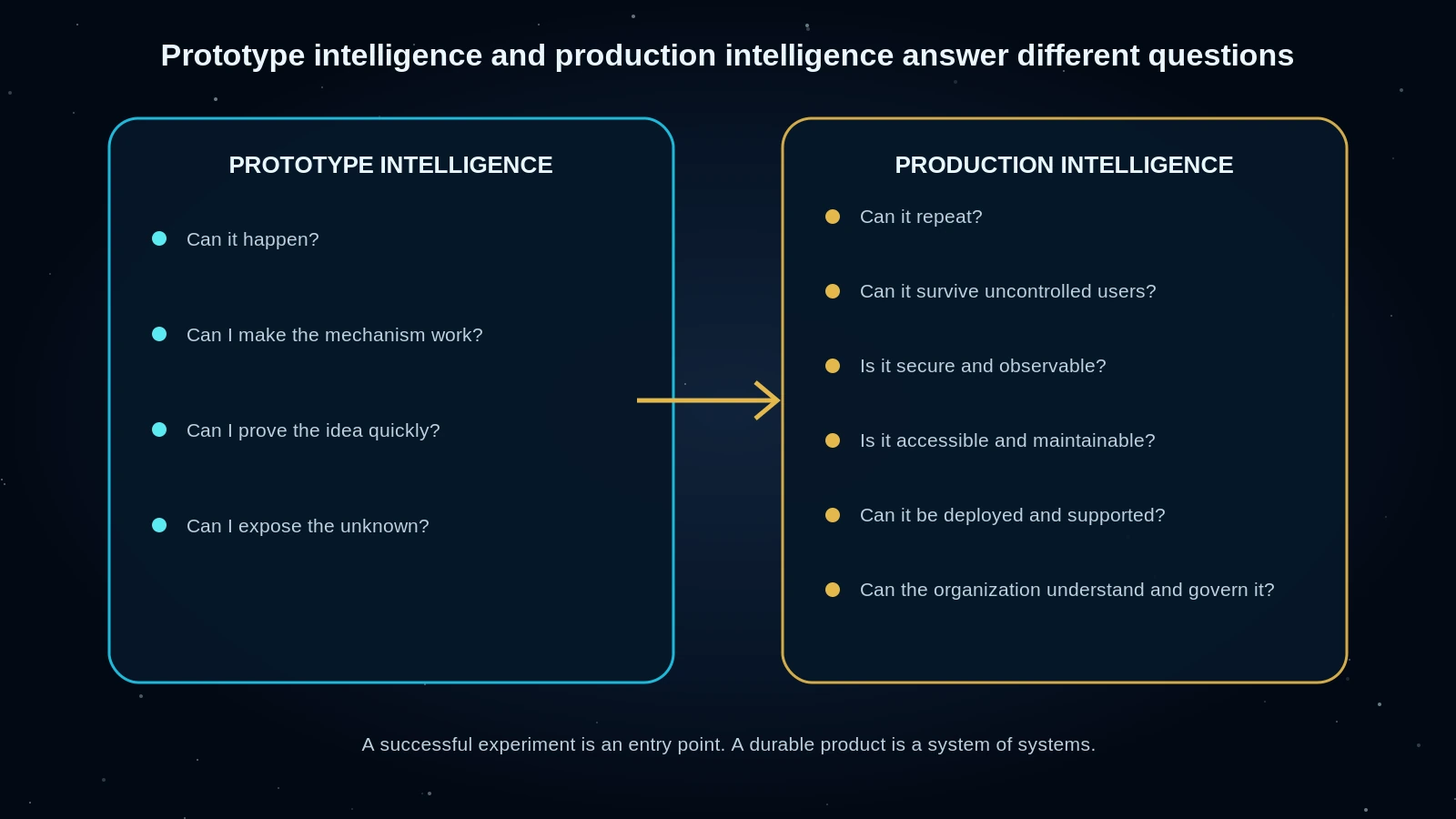
Prototype intelligence versus production intelligence
Complex explanatory diagram. Prototype intelligence proves the mechanism; production intelligence must also account for repeatability, users, security, observability, accessibility, maintenance, deployment, support, and governance.
9. Show Up Tomorrow
SOURCE MAPPDF p. 2There is another quality that never appears in glamorous profiles of technical prodigies:
reliability.
Can the person show up tomorrow?
And the day after that?
Can they work when the idea is no longer exciting?
Can they fix the ugly subsystem?
Can they document what they already understand?
Can they reproduce yesterday's result?
Can they tell somebody else how it works?
Can they take criticism?
Can they discover that they were wrong and change direction without collapsing?
Can they maintain something after the applause disappears?
Can they finish?
I have met brilliant people who could produce astonishing demonstrations and could not produce a stable artifact.
I have met less theatrical people who built systems that worked for years.
If I am building infrastructure, I know which person I want beside me.
Society benefits from finished capability, not merely visible cleverness.
10. Universities And The Strange Economics Of Expertise
SOURCE MAPPDF p. 2Now we get to a more uncomfortable subject.
I respect education.
I respect scholarship.
I respect professors who know their disciplines deeply and teach students how to reason.
But universities are not immune from structural failure.
The academic incentive system is not identical to the engineering incentive system.
A professor can be rewarded for:
publishing,
teaching,
obtaining grants,
developing theory,
advancing a specialized field,
and contributing to academic discourse.
Those are legitimate activities.
But none automatically demonstrates the ability to deliver a multidisciplinary production system.
Theory and application overlap.
They are not interchangeable.
And academia contains one of the strangest contradictions in modern society:
some extraordinarily intelligent people receive comparatively modest compensation while teaching knowledge that later produces immense commercial value elsewhere.
That does not prove that professors are secretly incompetent.
It proves something much more interesting:
intelligence, market value, institutional prestige, practical integration, and compensation are different variables.
People routinely confuse them.
A highly compensated executive is not automatically smarter than a professor.
A professor is not automatically better at operating a company than the executive.
A brilliant theoretician is not automatically a brilliant product architect.
A brilliant product architect is not automatically a brilliant researcher.
The mistake is assuming that excellence transfers automatically across contexts.
It does not.
11. If You Know So Much, Walk Into The Arena
SOURCE MAPPDF p. 2There is, however, a criticism of expert culture that I am willing to make without apology.
It is easy to explain why something cannot work while somebody else is carrying the risk of discovering whether it can.
There is safety in analysis.
There is safety in the sentence:
"The literature suggests..."
Good.
Now build something.
There is safety in:
"The accepted architecture is..."
Excellent.
Now test the alternative.
There is safety in saying:
"This would be extraordinarily difficult."
Of course it would.
That is why it is interesting.
I have more respect for the professor who says:
"I think you're wrong. Here is the experiment that will prove it. Let's run it."
than for a thousand authorities who explain why experimentation would be inconvenient.
The first person is practicing science.
The others may merely be protecting consensus.
12. The Warrior Is Not The Loudest Person
SOURCE MAPPDF p. 2When I say I want someone willing to stand up like a warrior, I do not mean theatrical aggression.
The technological warrior is the person willing to let reality injure their favorite idea.
They will test the assumption they desperately want to be true.
They will publish the failure.
They will challenge their own architecture.
They will walk into the unknown carrying enough discipline to return with useful information.
Courage in engineering is not shouting:
"I am right."
Courage is saying:
"Here is the test that could prove me wrong."
Then running it.
That is the kind of person I want around me.
13. Experts Can Become Guardians Of Yesterday
SOURCE MAPPDF p. 2Every mature discipline develops guardians.
Some are necessary.
They prevent old mistakes from returning.
But guardians can eventually confuse the walls they protect with the boundaries of reality.
A field develops conventional wisdom.
Then conventional wisdom becomes a curriculum.
The curriculum becomes credentialing.
Credentialing becomes authority.
Authority becomes hiring.
Hiring reproduces the curriculum.
Eventually somebody asks:
"Why exactly can't we do this differently?"
And the answer becomes:
"Because nobody does."
That is not an engineering constraint.
That is a cultural loop.
The person who breaks the loop often looks foolish immediately before they look obvious.
14. A Degree Is Evidence, Not Divinity
SOURCE MAPPDF p. 2A PhD means something.
It means a person completed serious work under the standards of a discipline.
It can represent enormous perseverance and expertise.
It does not mean:
omniscient.
Neither does:
MBA.
MD.
JD.
Professor.
Distinguished Fellow.
Senior Vice President.
Principal Engineer.
Founder.
Nothing does.
Titles are compression.
They tell us something about a person's history.
They do not absolve the person from demonstrating competence in the problem actually in front of us.
I expect the same rule to apply to me.
If I make a technical claim, do not believe it merely because I founded the company.
Look at the system.
Look at the mechanism.
Look at the measurement.
Then decide.
That is a healthier form of authority.
15. The Boardroom Makes The Same Mistake
SOURCE MAPPDF p. 2This matters tremendously in corporate governance.
Boards sometimes believe they can purchase intelligence by assembling prestigious resumes.
Put a famous technologist here.
A former executive there.
A professor over there.
Someone who worked at a recognizable company.
Wonderful.
Now answer the actual question:
Can these people understand this company?
Can they understand its customers?
Its architecture?
Its legal exposure?
Its economics?
Its users?
Its market timing?
Its technical constraints?
Its operational reality?
Its long-term strategy?
Can they distinguish a genuine risk from unfamiliarity?
Can they tell the difference between:
"This violates a known constraint"
and
"I personally have never seen this done"?
Those sentences are worlds apart.
A board that cannot tell the difference can destroy the very advantage it was hired to protect.
16. The Expert I Want
SOURCE MAPPDF p. 2I do want experts.
I want terrifyingly good ones.
I want the engineer who knows enough to destroy my favorite architecture in twenty minutes if it contains a fatal flaw.
I want the scientist who catches the assumption everyone else missed.
I want the attorney who sees the legal exposure before the product reaches the market.
I want the security researcher who finds the pathway nobody considered.
I want the designer who understands why the technically perfect control is unusable by an exhausted human being.
I want the economist who can explain why an elegant product fails commercially.
I want the operator who understands what happens at 3:17 in the morning when something breaks.
I want the person who can tell me:
"No. And here is the evidence."
What I do not want is:
"No, because people like us don't do that."
That is not expertise.
That is social conditioning.
17. Integration Is The Rare Skill
SOURCE MAPPDF p. 2The rarest person in technology may not be the deepest specialist.
It may be the person who can integrate deep specialists without destroying the coherence of the product.
Because the real product sits at intersections.
A medical product is not merely software.
It is medicine,
software,
human factors,
privacy,
billing,
regulation,
workflow,
economics,
liability,
accessibility,
hardware,
operations,
training,
and trust.
A financial system is not merely code.
A consumer product is not merely industrial design.
An AI system is not merely a model.
A company is not merely a product.
Everything important is connected to something outside its department.
That is why cohesive design is so difficult.
The person who sees only one layer frequently produces a technically excellent component that is unusable as a complete system.
18. The Common Crowd Is Easy To Impress
SOURCE MAPPDF p. 2This may sound harsh.
It is nevertheless true.
It is relatively easy to impress someone who does not understand the field.
Flash some terminal output.
Show them an animation.
Use technical vocabulary.
Put a graph on a dark background.
Say "neural."
Say "quantum."
Say "military-grade."
Say "enterprise."
Someone will be impressed.
That proves nothing.
The standard I care about is whether the artifact survives increasing levels of understanding.
A novice should be able to use it.
An engineer should be able to inspect it.
A security professional should be able to challenge it.
An executive should understand why it matters.
A board should understand the risk.
An investor should understand the opportunity.
A regulator should understand the controls.
A maintainer should understand the architecture.
If the product becomes more impressive the more somebody understands it, now we are getting somewhere.
19. Do Not Confuse Precocity With Completion
SOURCE MAPPDF p. 2I love prodigies.
A child who programs at ten deserves encouragement.
A teenager who understands electronics deserves access to equipment.
A college student who builds something astonishing deserves attention.
But society sometimes damages talented young people by confusing early ability with completed development.
A brilliant ten-year-old who automates a toaster has demonstrated:
curiosity,
technical aptitude,
initiative,
perhaps unusual intelligence.
Wonderful.
Now give them another twenty years of problems.
Let them fail.
Let them work with people.
Let them maintain systems.
Let them learn economics.
Let them encounter users.
Let them build something somebody else's livelihood depends on.
Let them discover that hardware has tolerances.
Let them get something wrong in production.
Let them learn why documentation matters.
Let them learn why somebody else's apparently stupid requirement existed.
The goal should not be to tell the child:
"You are already Steve Jobs."
The goal should be:
"You have demonstrated something worth developing. Keep going."
That distinction protects talent.
20. Genius Is Not A Moment
SOURCE MAPPDF p. 2I think society has an unhealthy fascination with the moment of inspiration.
The garage.
The napkin.
The prototype.
The first line of code.
The dramatic breakthrough.
Those moments make excellent movies.
They are a tiny fraction of creation.
The real work happens afterward.
Iteration 17.
Version 43.
The bug nobody wants to touch.
The documentation.
The deployment script.
The manufacturing problem.
The legal issue.
The argument with the vendor.
The customer who misunderstood the product.
The requirement nobody anticipated.
The redesign.
The second redesign.
The failure.
The lesson.
The next version.
Genius that cannot survive repetition is merely a good afternoon.
21. Society Needs Builders, Not Performers
SOURCE MAPPDF p. 2This is ultimately what bothers me.
Modern culture rewards the performance of expertise.
People learn how to look technical.
How to sound academic.
How to speak like executives.
How to pitch.
How to use the vocabulary.
How to perform confidence.
I care about something much more boring.
Can you build?
Can you produce a clean artifact?
Can somebody reproduce your result?
Can another person understand the architecture?
Can the work survive your absence?
Can it meet standards?
Can it solve an actual problem?
Can it become useful to society?
Can you improve it after discovering that you were wrong?
That is the standard.
Not the applause.
22. A Complete Product Is An Act Of Synthesis
SOURCE MAPPDF p. 2The deeper reason I care about this distinction is that complete products require synthesis.
You must eventually make all the contradictions occupy the same object.
Beautiful and manufacturable.
Secure and usable.
Powerful and understandable.
Flexible and governable.
Innovative and maintainable.
Fast and correct.
Advanced and accessible.
Interesting to engineers and valuable to customers.
Profitable enough to survive and useful enough to deserve survival.
You do not solve that with a weekend course.
You solve it through accumulated judgment.
And judgment is built through repeated contact with consequences.
23. Stop Asking Who Is Impressive
SOURCE MAPPDF p. 2Ask better questions.
What has this person actually built?
Does it work?
Under what conditions?
Can it be reproduced?
Can they explain why it works?
Do they understand where it fails?
Can they improve it?
Can somebody else maintain it?
Can they collaborate?
Can they make hard tradeoffs?
Can they integrate disciplines?
Can they finish?
Can they admit they were wrong?
Can they show up again tomorrow?
That is a far more useful evaluation than:
"Is he good with computers?"
24. Build The Whole Machine
SOURCE MAPPDF p. 2I do not care whether somebody knows Python.
I care what they can do with what they know.
I do not care whether somebody can solder an Arduino.
I care whether they understand the system they are building.
I do not care whether somebody has a PhD.
I care whether their model survives the experiment.
I do not care whether somebody is famous for design.
I care whether they understand why the design works.
I do not care whether the room thinks somebody is brilliant.
I care whether reality agrees.
Because society does not ultimately run on demonstrations of cleverness.
It runs on systems.
Hospitals.
Networks.
Aircraft.
Courts.
Supply chains.
Software.
Power grids.
Communication systems.
Companies.
Products.
Tools.
Institutions.
All of them depend on somebody eventually doing the unglamorous work of turning an idea into something complete.
A weekend crash course can begin a journey.
A Raspberry Pi can awaken a mind.
An Arduino can reveal an engineer.
A university can cultivate extraordinary intelligence.
A professor can reshape a field.
A teenager can surprise an industry.
A newcomer can see what veterans missed.
I believe all of that.
But none of it eliminates the final standard.
Build the whole machine.
Make it clean.
Make it reproducible.
Make it understandable.
Make it maintainable.
Make it useful.
Make it survive reality.
And then come back tomorrow and make it better.
That is the difference between knowing how to make something happen and knowing how to build something that matters.
The Founder
Keep exploring // human pathways
Continue through adjacent ideas, products, principles, and historical lineages. These pathways preserve the relationships in the underlying knowledge graph while keeping exploration natural for a human reader.
 publicationThe Experts Who Would Have Stopped The Machine
Founder essay on evidence, experimentation, expertise, competition, falsifiability, governance, and selecting advisers or directors who update when results contradict assumptions.
CONTINUE →collectionFounder PublicationsThe complete eight-publication founder corpus: source-preserved essays, research monographs, and benchmark reports published as canonical human articles with governed fragments, provenance, affective context, media, and machine-readable representations.
CONTINUE → entityThe Founder
A privacy-preserving founder profile focused on technical lineage, systems literacy, operating philosophy, cross-domain study, and the design principles visible in XERXES SI—without publishing age, identity, or unnecessary personal detail.
CONTINUE →entityXERXES SIXERXES SI is the company entity connecting the public product, architecture, demonstration, evidence, investor, and knowledge properties.
CONTINUE →