About XERXES Lattice
The wiki is the human interface. The Lattice is the knowledge architecture.
What kind of wiki is this?
XERXES Lattice is a modular authority web designed for two audiences at once: people who want valuable, browsable explanations and machines that need stable identities, explicit relations, provenance, and structured representations.
The design rule is breadth without losing structure. Human pages can be visual, historical, opinionated where clearly labeled, and full of adjacent paths. Underneath, the same information remains governed by canonical JSON objects and reproducible builds.
One truth, multiple representations
Each public object has one stable semantic identity and can be rendered as human HTML, portable Markdown, and machine-oriented JSON-LD. Future adapters can expose MCP, NLWeb, feeds, or database-backed query without making a second truth.
canonical object → HTML
                 → Markdown
                 → JSON-LD
→ future agent adaptersPublic page vs. control plane
Public pages contain only intentionally disclosed knowledge. Build instructions, source research notes, deployment secrets, private founder evidence, naming discussions, and internal design rationale live outside the deployable payload.
Familiar doorway, unusual machine
The visual system borrows the confidence and cinematic restraint of the XERXES SI ecosystem while keeping the reading plane calmer than the public demonstrations. Retro-computing references appear as small recognition signals, not as a costume that competes with the knowledge.
Why it feels different
XERXES Lattice is designed as a serious reference system first. Its visual perimeter carries small signals from earlier computing cultures—catalogs, shells, physical media, workstation coherence, presence indicators, printed references—because those eras taught durable lessons about constraints, discovery, community, and systems literacy.
Historic references are expressed through original interface motifs and prose. The public site does not reproduce third-party magazine covers, game art, software logos, or trademarked interface assets as decorative nostalgia.
Keep exploring // human pathways
Continue through adjacent ideas, products, principles, and historical lineages. These pathways preserve the relationships in the underlying knowledge graph while keeping exploration natural for a human reader.
A governed, human-first and machine-readable knowledge system: stable modular objects become visual articles, Markdown, JSON-LD, search, source bridges, media registries, sitemaps, and navigable relations without duplicating the truth by hand.
CONTINUE →systemLattice Site MapHuman-readable discovery map for XERXES Lattice, paired with the canonical XML sitemap for search engines.
CONTINUE → publicationClean Systems Win
A founder essay on structural literacy, security methodology, reverse engineering, institutional memory, KAIZEN, standards-first development, and why SIDE is intended to turn accumulated engineering knowledge into active development constraints.
CONTINUE →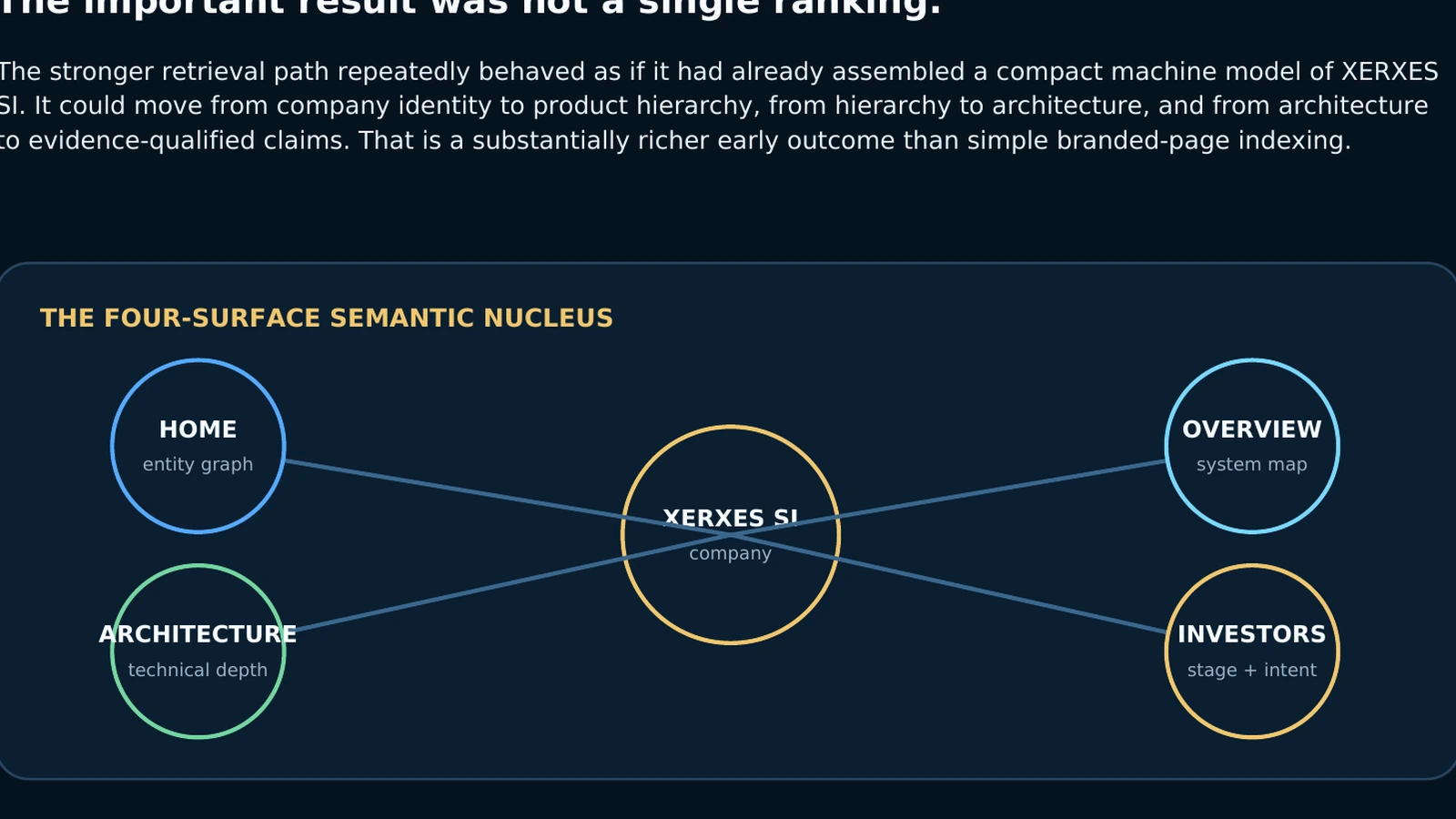 publicationData Points Proof of Concept
A longitudinal proof-of-concept report documenting first-day semantic retrieval behavior around XERXES SI, including a repeated four-surface semantic nucleus, architecture-level passage retrieval, relationship reconstruction, an internal expectation index, and specific architecture-control ratios supporting approximately 1.04 to 1.25 orders of magnitude reduction in the reported tests.
CONTINUE →