
Clean Systems Win
Why I Recommend OSSTMM, ISECOM, Hardware Hacking, KAIZEN, and Standards-First Engineering

Source document // the argument begins
SOURCE MAPPDF p. 3Clean Systems Win
Why I Recommend OSSTMM, ISECOM, Hardware Hacking, KAIZEN, and Standards-First Engineering
There is a peculiar mistake people make when they talk about creativity.
They imagine creativity as disorder.
They picture the inventor as someone surrounded by chaos, violating every rule, ignoring every standard, throwing components together until lightning strikes and something brilliant appears.
Sometimes discovery begins that way.
Professional engineering cannot end that way.
The difference between an interesting experiment and a durable system is structure.
The difference between somebody who can produce one clever prototype and somebody who can repeatedly build things that survive contact with users, attackers, regulators, hardware limitations, accessibility requirements, corporate deployment, maintenance, and time is discipline.
That distinction has shaped almost everything I build.
I love unconventional ideas.
I am deeply suspicious of conventional assumptions.
But I have never believed that originality excuses dirtiness.
In fact, I believe almost the opposite:
the more unusual the architecture, the cleaner the engineering surrounding it must become.
If you intend to challenge established assumptions, you cannot afford ambiguity in your own work.
You need clean boundaries.
Clean records.
Clean interfaces.
Clean tests.
Clean provenance.
Clean security assumptions.
Clean failure analysis.
Clean standards.
And most importantly, you need a system capable of learning from its own mistakes without repeatedly rediscovering them.
That is why there is a particular family of technical literature I have always considered important.
Among the books and methodologies I recommend are:
Hacking Exposed Linux, Third Edition: Linux Security Secrets and Solutions, credited to the Institute for Security and Open Methodologies - ISECOM.
The Open Source Security Testing Methodology Manual - OSSTMM, created and maintained by ISECOM.
Hacking the Cable Modem: What Cable Companies Don't Want You to Know, by DerEngel.
And Hacking the Xbox: An Introduction to Reverse Engineering, by Andrew "bunnie" Huang.
They are very different works.
But there is a common intellectual thread running through all of them.
They teach you to stop looking at the label on the box.
Open the box.
1. The Most Dangerous Sentence In Engineering
SOURCE MAPPDF pp. 2–25There is a sentence I dislike hearing:
"That is just how it works."
No.
That is how someone says it works.
Those are not necessarily the same thing.
One of the intellectual virtues of hacker culture at its best was the refusal to confuse an interface with the system underneath it.
A cable modem presented itself as an appliance.
An Xbox presented itself as a game console.
Linux presented itself as an operating system.
A network presented itself as a collection of services.
The interesting person asks another question:
What is actually happening underneath?
Where is state stored?
What trusts what?
What happens before the operating system loads?
Which processor executes first?
What is signed?
What is not?
Where does configuration come from?
What can the hardware see that the software pretends does not exist?
What assumptions did the designers make?
What happens when one assumption is deliberately violated?
That mindset is not inherently destructive.
It is one of the purest forms of engineering curiosity.
You cannot truly design systems until you become comfortable looking beneath their abstractions.
2. Hacking Exposed Linux: Learn The System, Not The Checkbox
SOURCE MAPPDF p. 25The specific edition I recommend discussing here is:
Hacking Exposed Linux, Third Edition: Linux Security Secrets and Solutions
- the ISECOM edition.
That attribution matters.
ISECOM is the Institute for Security and Open Methodologies, an open security-research organization that began in 2001 around publication of the Open Source Security Testing Methodology Manual.
The third edition of Hacking Exposed Linux sits naturally inside that intellectual tradition.
The lesson is not:
memorize Linux attack commands.
That would be shallow.
The lesson is:
understand a system deeply enough that security stops being mystical.
Linux is an extraordinarily useful environment for learning this because the abstraction can be peeled away.
A process is not magic.
Permissions are not magic.
Sockets are not magic.
Filesystems are not magic.
Authentication is not magic.
Privilege is not magic.
A daemon is just software with a particular relationship to the operating environment.
Once you understand the relationships, you begin to understand where trust actually resides.
And once you can locate trust, you can ask the most important security question:
Is that trust justified?
That question applies far beyond Linux.
It applies to corporations.
It applies to artificial intelligence.
It applies to development pipelines.
It applies to identity systems.
It applies to software supply chains.
It even applies to knowledge.
3. Osstmm: Stop Saying "Secure"
SOURCE MAPPDF pp. 2–25This is why I still think the OSSTMM - the Open Source Security Testing Methodology Manual - is conceptually important.
Security is one of the most abused words in technology.
People say:
"This is secure."
What does that mean?
Secure against whom?
Under what conditions?
At what boundary?
Measured how?
For how long?
With what access?
Against which capability?
What was actually tested?
Who performed the test?
What did they not test?
What assumptions were excluded from scope?
A methodology forces those questions into the room.
That is what I admire about the OSSTMM mindset.
The OSSTMM treats security testing as something that requires defined scope, defined interactions, defined measurement, and disciplined analysis.
That sounds obvious.
It is not obvious in practice.
A remarkable amount of professional technology still operates on security theater:
run a scanner,
generate a report,
check a box,
call the system secure.
That is not measurement.
That is ritual.
A serious methodology should reduce a complicated environment into understandable interactions, establish what is being measured, and make it possible for another competent person to understand what was actually tested.
That attitude had an enormous influence on how I think.
Do not tell me the system is good. Show me what you measured.
4. Hacking The Cable Modem: The Appliance Is Lying To You
SOURCE MAPPDF p. 25Then there is Hacking the Cable Modem: What Cable Companies Don't Want You to Know.
Read the title carefully.
The interesting word is not "hacking."
The interesting object is the cable modem.
For most consumers, a cable modem was nearly invisible.
Coax went in.
Ethernet came out.
Lights blinked.
Internet happened.
End of intellectual inquiry.
But the box contained processors, firmware, configuration mechanisms, provisioning behavior, network relationships, service-provider controls, diagnostic capabilities, trust assumptions, and implementation decisions.
Suddenly the boring plastic box became a system.
That transformation is important.
A hacker looks at an appliance and sees layers.
That is the lesson I care about.
Not stealing service.
Not bypassing payment.
Not damaging infrastructure.
Those are legal and ethical questions separate from the technical value of understanding the architecture.
The valuable lesson is that a device marketed as an indivisible object is almost never indivisible.
There is firmware.
There is hardware.
There are protocols.
There are boot processes.
There are management interfaces.
There are boundaries between what the manufacturer intended and what the machine is physically capable of doing.
There are often assumptions nobody notices until someone asks the machine directly.
That habit of thought is invaluable.
Because once you see one black box this way, you start seeing every black box this way.
5. Hacking The Xbox: Reverse Engineering As Literacy
SOURCE MAPPDF p. 25Andrew "bunnie" Huang's Hacking the Xbox: An Introduction to Reverse Engineering belongs in the same intellectual family for a different reason.
The original Xbox was designed as a consumer appliance.
To most people:
plug it into the television,
insert a game,
press a button,
play.
To a hardware engineer, it was a computer system containing buses, flash memory, cryptographic protections, boot logic, interfaces, processors, trust boundaries, and assumptions.
Bunnie looked below the product identity.
That matters.
The book is valuable because it demonstrates that reverse engineering is not merely "breaking" something.
Reverse engineering is often a process of reconstructing the design decisions embedded in an artifact.
The hardware becomes a document.
The bus becomes a sentence.
The boot sequence becomes an argument.
A protection mechanism becomes a statement by one engineer to another:
"We believe this boundary will hold."
The reverse engineer replies:
"Why?"
That is a magnificent question.
Not because the original engineer was stupid.
Quite the opposite.
The most interesting systems are often designed by very capable people.
That is precisely why defeating an assumption or discovering an overlooked pathway teaches something useful.
You are studying the boundary between design intent and physical reality.
Every engineer should understand that distinction.
6. The Hacker And The Designer Are Closer Than They Think
SOURCE MAPPDF pp. 7–8The best hacker and the best designer share a personality trait:
neither accepts the visible surface as the complete explanation.
The hacker asks:
What did the designer assume?
The designer asks:
What will the user do that I did not anticipate?
The hacker asks:
Where is the trust boundary?
The designer asks:
Where should the trust boundary be?
The hacker asks:
What happens if I violate this assumption?
The designer asks:
How do I make the system behave safely when this assumption fails?
At their highest level, these are not opposing professions.
They are complementary ways of interrogating reality.
That is why security cannot be an afterthought.
A development system should carry the adversarial question inside the act of creation.
7. Tempest: The Computer Is Talking Even When You Think It Is Silent
SOURCE MAPPDF p. 8If you want an example of why standards matter, study the history behind TEMPEST.
Most programmers think about information as something traveling through an intentional channel:
a file,
a network packet,
a database query,
a display,
a speaker.
But electronic systems exist in physics.
They radiate.
They switch.
They couple.
They generate electromagnetic energy.
They can produce acoustic and electromagnetic emanations correlated with the information they process.
That means a computer can disclose information through channels its software designer never thought of as channels at all.
That realization should permanently change the way an engineer thinks.
The system does not care what your architecture diagram says.
Physics has its own architecture diagram.
TEMPEST and the broader discipline surrounding compromising emanations remind us that information security is not merely a software property.
A beautifully written application can sit on top of an insecure operating environment.
A hardened operating system can run on leaking hardware.
A protected network can terminate in a badly designed physical space.
A sophisticated cryptographic implementation can still coexist with unintended side channels.
The lesson is larger than TEMPEST itself:
Every abstraction leaks eventually into reality.
Professional development has to respect that.
8. Standards Are Compressed Mistakes
SOURCE MAPPDF p. 2This is how I think about standards.
A good standard is often compressed institutional pain.
Somebody discovered the problem before you.
Some system failed.
Some vulnerability escaped.
Some interoperability assumption broke.
Some equipment leaked.
Some user was excluded.
Some organization paid an enormous price to discover that something everyone considered harmless was not harmless.
Eventually enough experience accumulated that someone said:
We should stop rediscovering this.
And a rule, procedure, specification, or standard emerged.
That does not make every standard perfect.
Standards can become obsolete.
They can become bureaucratic.
They can be written badly.
They can lag technology.
A leader must be capable of challenging a standard when reality justifies doing so.
But dismissing standards because they constrain creativity is juvenile engineering.
A mature engineer asks:
What historical failure is this requirement trying to prevent?
That question often reveals the intelligence hidden inside the rule.
9. Apple And The Difference Between Shape And Design
SOURCE MAPPDF p. 2This brings us to design.
People copy Apple constantly.
Very few understand Apple.
They copy:
rounded rectangles,
minimal interfaces,
speaker grilles,
materials,
spacing,
typography,
animation,
packaging.
That is not design.
That is archaeology performed by someone who cannot read the language.
A finished product contains the residue of thousands of decisions.
Why is the speaker there?
Why is the port there?
Why is the opening that size?
Why is one component isolated?
Why did the previous generation place something differently?
What resonance occurred?
What interference appeared?
What assembly constraint existed?
What happened to thermals?
What did users cover with their hand?
What made manufacturing difficult?
What accumulated tolerance caused failures?
What happened during repair?
What did the previous geometry teach the next team?
Strong design organizations preserve why.
That institutional memory is more valuable than the drawing.
I use Apple as an illustration because the finished Apple object is so frequently imitated while the reasoning that produced it is not.
I am not claiming access to Apple's private engineering records.
The point is the methodology any serious design organization requires:
do not merely preserve what you built; preserve why you built it that way.
If a speaker was moved because the previous location caused an acoustic, structural, thermal, ergonomic, manufacturing, or interference problem, the next generation should not have to discover the same problem from zero.
Otherwise the company has employees but no memory.
10. An Organization Without Memory Is Not Intelligent
SOURCE MAPPDF p. 2This is one of the most important ideas in this essay.
A corporation can have brilliant people and still be stupid.
How?
Simple.
Let the lessons disappear when the people leave.
Let failures remain undocumented.
Let decisions be recorded without rationale.
Let teams repeat experiments because nobody can find the previous results.
Let engineers fix symptoms without recording causes.
Let software be rewritten because nobody understands why the strange-looking old code existed.
Let every management generation rediscover the same organizational failures.
You can employ thousands of intelligent people while maintaining an unintelligent institution.
That is unacceptable to me.
An intelligent organization should accumulate cognition.
It should remember:
what happened
why it happened
what we believed before it happened
what evidence changed our belief
what correction was made
whether the correction worked
and
what future designers must not accidentally undo.
This is not documentation for documentation's sake.
This is corporate memory.
11. Kaizen: Do Not Worship The First Successful Version
SOURCE MAPPDF p. 2This is where KAIZEN becomes essential.
KAIZEN is commonly translated as continuous improvement.
I think many organizations hear that phrase and reduce it to motivational wallpaper.
That misses the point.
Toyota's culture tied continuous improvement to standardized work, reflection on what went wrong, preserving what went right, and feeding those lessons back into the process.
That is enormously important.
Standardization and innovation are not enemies.
Standardization gives improvement something to measure against.
If everyone performs a process differently every time, how do you know whether your change improved it?
You need a baseline.
Then:
observe,
change,
measure,
learn,
standardize what improved,
repeat.
The standard is not the graveyard of innovation.
It is the checkpoint from which the next innovation departs.
That is KAIZEN.
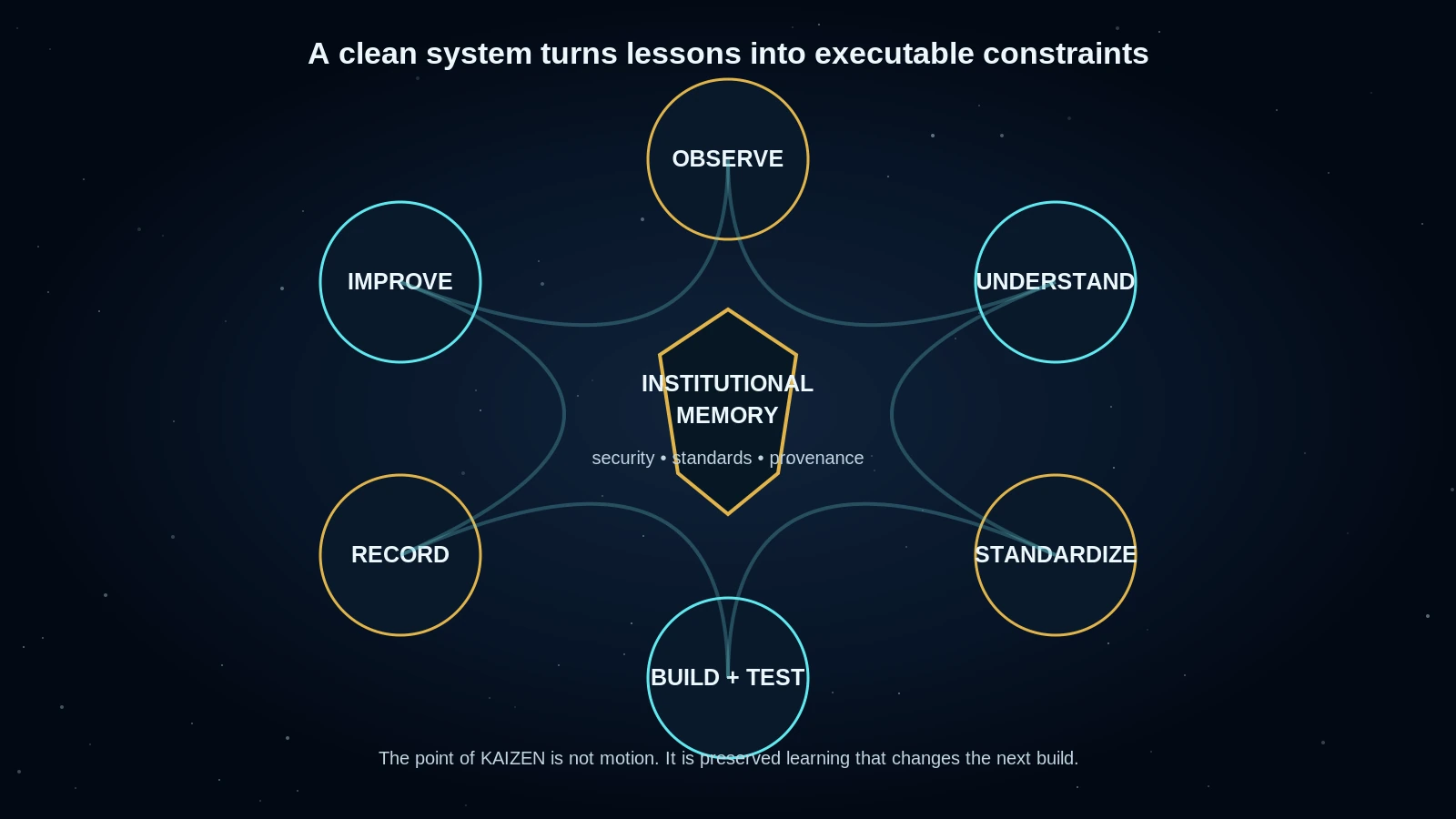
Lessons become executable constraints
Complex systems diagram showing a KAIZEN-like cycle around institutional memory: observe, understand, standardize, build and test, record, improve, and repeat.
12. The Difference Between Followers And Leaders
SOURCE MAPPDF p. 2A follower looks at a successful product and asks:
What should ours look like?
A leader asks:
What problem produced that design?
A follower copies the solution.
A leader reconstructs the constraints.
A follower copies today's interface.
A leader studies yesterday's failure.
A follower wants best practices.
A leader wants to know what evidence caused the practice to become "best."
A follower asks which framework everyone else uses.
A leader asks which invariants any successful framework must preserve.
A follower waits for the standard.
A leader may help discover why the standard is necessary.
That is the distinction.
Leadership does not mean ignoring accumulated knowledge.
Leadership means understanding accumulated knowledge deeply enough to know where it ends.
13. Creativity Without Structure Becomes Technical Debt
SOURCE MAPPDF p. 2There is a seductive development pattern:
build rapidly,
ignore standards,
ignore accessibility,
ignore threat modeling,
ignore packaging,
ignore provenance,
ignore data lifecycle,
ignore auditability,
ignore deployment requirements,
ignore enterprise controls,
ignore error handling,
ignore upgrade paths,
get the demo working.
Then everyone celebrates.
Six months later the company discovers that the "working product" cannot actually become the product.
Security requires architectural changes.
Accessibility requires UI reconstruction.
Enterprise deployment requires identity changes.
Compliance changes storage.
Observability changes execution pathways.
Packaging breaks dependencies.
Configuration has become scattered.
Permissions are inconsistent.
Secrets are everywhere.
The prototype becomes an archaeological site.
Now the company has two choices:
keep patching,
or rewrite it.
Both are expensive.
This is one of the greatest hidden costs in software.
The industry calls it moving fast.
Very often it is simply borrowing time from the future at a terrible interest rate.
14. Security Cannot Be Something You Remember Later
SOURCE MAPPDF p. 2Modern secure-development guidance increasingly recognizes what good security engineers understood long ago:
security practices need to be integrated into the software-development lifecycle.
That sounds painfully obvious.
Yet entire businesses still operate as though security is a ceremonial review performed shortly before release.
Someone builds the thing.
Someone else scans it.
A report appears.
Engineering gets a list of vulnerabilities.
Management becomes angry.
Everyone patches.
The architecture remains unchanged.
Then the cycle repeats.
That is not security engineering.
That is vulnerability janitorial work.
The correct question comes much earlier:
Why was this class of defect structurally easy to introduce?
Fix that.
Then the next product inherits the improvement.
15. This Is Why I Built Side
SOURCE MAPPDF p. 2This is the point where all of these threads converge.
SIDE - the Synthetic Intelligence Development Environment - exists because I do not want engineering discipline added after creation.
I want discipline inside the act of creation.
SIDE is not interesting to me merely because software can be created within it.
Editors already exist.
IDEs already exist.
Build systems already exist.
Code generators already exist.
The problem I wanted to address is larger.
I want a development environment capable of carrying the organization's engineering expectations forward with the work.
Standards.
Security assumptions.
Accessibility.
Packaging discipline.
Documentation.
Provenance.
Testing requirements.
Deployment expectations.
Modularity.
Version relationships.
Auditability.
Corporate requirements.
Machine-readable knowledge.
Lessons learned.
Not as a checklist somebody remembers at the end.
As part of the development substrate.
16. The Product Should Be Born Closer To Production
SOURCE MAPPDF p. 2Think about the difference.
Conventional pathway
Idea
-> prototype
-> features
-> demo
-> rewrite for security
-> rewrite for enterprise deployment
-> retrofit accessibility
-> retrofit documentation
-> retrofit observability
-> repair packaging
-> discover compliance requirements
-> architecture changes
-> regression failures
-> production
SIDE philosophy
Idea
-> structured environment
-> standards-aware creation
-> security-aware architecture
-> accessible primitives
-> governed dependencies
-> testable modules
-> documented relationships
-> reproducible packaging
-> auditable output
-> progressively qualified production artifact
The second pathway does not eliminate iteration.
It changes what iteration is spent on.
Instead of wasting iteration repeatedly cleaning old mistakes, you can spend more iteration improving the product itself.
That is leverage.
17. Standards Should Become Executable Knowledge
SOURCE MAPPDF p. 2This is where SIDE can eventually go far beyond conventional development environments.
A PDF containing a standard is useful.
A developer remembering the standard is better.
A checklist derived from the standard is better still.
But the most interesting state is:
the development environment understands enough of the standard to help enforce its intent.
That is where documentation becomes executable institutional knowledge.
A requirement should be capable of becoming:
a constraint,
a lint rule,
a build condition,
a schema,
a test,
a permission boundary,
a deployment requirement,
a warning,
an automated remediation,
or a review gate.
That changes standards from passive literature into active engineering memory.
And that is what I want.
18. Side As Institutional Memory
SOURCE MAPPDF p. 2The implications go beyond security.
Imagine that a team discovers:
Component A cannot safely communicate with Component B under condition C.
A conventional organization fixes the bug.
A better organization writes a note.
An excellent organization creates a regression test.
The organization I want creates the test, records the rationale, links the failure, attaches the affected architecture, records the corrected relationship, and allows future development tools to prevent the same mistake from quietly reappearing.
That is continuous improvement implemented at the system level.
The lesson does not merely live in someone's head.
It becomes part of the development environment.
That is KAIZEN expressed computationally.
19. The Lattice And Side Solve Two Halves Of The Same Problem
SOURCE MAPPDF p. 2The Lattice and SIDE therefore belong to the same philosophy.
The Lattice preserves what the organization knows.
SIDE helps preserve how the organization builds.
The Lattice asks:
What do we know, why do we believe it, and how are the concepts connected?
SIDE asks:
Given what we know, how should that knowledge constrain the next thing we build?
One is epistemic structure.
The other is productive structure.
Together they form something much more interesting than documentation plus an IDE.
They create a pathway by which organizational learning can influence future construction.
That is the real objective.
20. Why Cleanliness Makes Creativity Faster
SOURCE MAPPDF p. 2People hear all this and imagine bureaucracy.
That means they have experienced bad systems.
Good structure does not slow creativity.
Bad structure does.
A clean development environment means the creative person does not have to remember fifty invisible obligations every time they build something.
The system carries them.
A pilot does not become less capable because an aircraft has instrumentation.
A surgeon does not become less skilled because an operating room has sterile procedure.
A physicist does not become less creative because measurements use defined units.
Structure eliminates avoidable cognitive waste.
Then creativity has more room.
The goal of SIDE is not to surround the engineer with rules.
The goal is to make the rules that matter disappear into the environment.
The engineer should experience freedom.
The product should inherit discipline.
21. The Lesson Of The Hacker
SOURCE MAPPDF p. 2This brings us back to those books.
Hacking Exposed Linux.
Hacking the Cable Modem.
Hacking the Xbox.
OSSTMM.
Why would I put them on a founder's recommended-reading list?
Because they teach something deeper than security.
They teach respect for mechanisms.
They teach the arrogance of assuming the visible interface is the whole machine.
They teach that implementations contain assumptions.
They teach that assumptions can be tested.
They teach that trust boundaries can be examined.
They teach that hardware matters.
They teach that software matters.
They teach that protocols matter.
They teach that the physical world matters.
They teach that documentation can be wrong.
They teach that engineers can be brilliant and still miss something.
And most importantly:
they teach you to look.
That habit is priceless.
22. The Lesson Of Kaizen
SOURCE MAPPDF p. 2KAIZEN adds the missing half.
Hacker culture says:
Find what everyone else missed.
KAIZEN says:
Once you find it, make sure the organization never has to discover it from scratch again.
That combination is extraordinarily powerful.
Discovery without institutional memory produces repeated heroics.
Institutional memory without discovery produces bureaucracy.
I want neither.
I want:
discovery -> measurement -> correction -> preservation -> improvement.
Then repeat.
That is an intelligent organization.
23. The Organization I Want To Build
SOURCE MAPPDF p. 2I do not want XERXES SI to become a company where creativity happens despite the process.
I want the process to protect creativity from waste.
I do not want security people arriving at the end to explain why everything has to be rebuilt.
I want security reasoning embedded early enough that the architecture grows correctly.
I do not want accessibility treated as charity after release.
I want accessibility recognized as engineering.
I do not want standards treated as paperwork.
I want them converted into usable constraints and reusable knowledge.
I do not want mistakes hidden because somebody is afraid of embarrassment.
I want mistakes harvested.
A mistake is expensive information.
Do not pay for the same information twice.
That may be one of the simplest descriptions of KAIZEN I know.
24. Original Design Is Memory Plus Courage
SOURCE MAPPDF p. 2Original design requires courage because at some point you have to do something nobody around you can guarantee will work.
But courage without memory is recklessness.
The great designer carries two things simultaneously:
everything we have already learned
and
the willingness to discover that some of it is wrong.
That is the equilibrium.
Standards without experimentation stagnate.
Experimentation without standards decays.
Security without creativity becomes ritual.
Creativity without security becomes liability.
Documentation without execution becomes bureaucracy.
Execution without documentation becomes amnesia.
SIDE exists in the tension between those extremes.
That is precisely where I want it.
25. Clean Systems Win
SOURCE MAPPDF p. 2A clean system is not one that never fails.
That system does not exist.
A clean system is one that can understand its failure.
A clean organization is not one that never makes mistakes.
It is one that does not repeatedly make the same mistakes without learning.
A clean architecture is not one with the fewest components.
It is one in which the relationships between components are deliberate, inspectable, and understandable.
A clean standard is not one that prohibits experimentation.
It is one that preserves hard-earned knowledge while leaving room for better knowledge to replace it.
And a clean development environment is not one that controls the developer.
It is one that quietly carries the accumulated intelligence of the organization so the developer can concentrate on what has never been done before.
That is why I recommend the OSSTMM.
That is why I recommend the work of ISECOM.
That is why I recommend Hacking Exposed Linux, Third Edition.
That is why I recommend Hacking the Cable Modem: What Cable Companies Don't Want You to Know.
That is why I recommend Andrew "bunnie" Huang's Hacking the Xbox: An Introduction to Reverse Engineering.
That is why I study KAIZEN.
That is why standards such as TEMPEST matter.
And that is one of the fundamental reasons I built SIDE.
I do not want to build products that succeed because we managed to outrun our mistakes.
I want the mistakes to become knowledge.
I want the knowledge to become structure.
I want the structure to become tooling.
I want the tooling to make the next product cleaner than the last one.
And then I want to repeat that cycle until continuous improvement is no longer something written on a management slide.
It is something the development system itself knows how to do.
Creativity gives us somewhere new to go.
Structure is what lets us arrive with the machine intact.
The Founder
Keep exploring // human pathways
Continue through adjacent ideas, products, principles, and historical lineages. These pathways preserve the relationships in the underlying knowledge graph while keeping exploration natural for a human reader.
The complete eight-publication founder corpus: source-preserved essays, research monographs, and benchmark reports published as canonical human articles with governed fragments, provenance, affective context, media, and machine-readable representations.
CONTINUE →lineageOSSTMMThe Open Source Security Testing Methodology Manual (OSSTMM) from ISECOM organizes security testing around operational methodology, trust analysis, human/physical/wireless/telecommunications/data-network channels, and reporting.
CONTINUE →productSIDESIDE is the Synthetic Intelligence Development Environment in the XERXES SI ecosystem: a governed environment for building, packaging, testing, and reproducing systems.
CONTINUE → entityThe Founder
A privacy-preserving founder profile focused on technical lineage, systems literacy, operating philosophy, cross-domain study, and the design principles visible in XERXES SI—without publishing age, identity, or unnecessary personal detail.
CONTINUE →