Data Points Proof of Concept
Early Semantic Performance
Early semantic performance // proof of concept
SOURCE MAPPDF p. 1A source-preserved August 2026 proof-of-concept report on how rapidly retrieval systems began reconstructing XERXES SI as a coherent company, architecture, product graph, and evidence corpus.
The source reports that same-day retrieval recovered the four-surface nucleus and deep architecture passages earlier and with more structure than the founder expected for such a new public entity.
What exceeded expectation
SOURCE MAPPDF p. 2The earliest benchmark window produced not only discoverability, but coherent relationship reconstruction and passage-level technical retrieval.
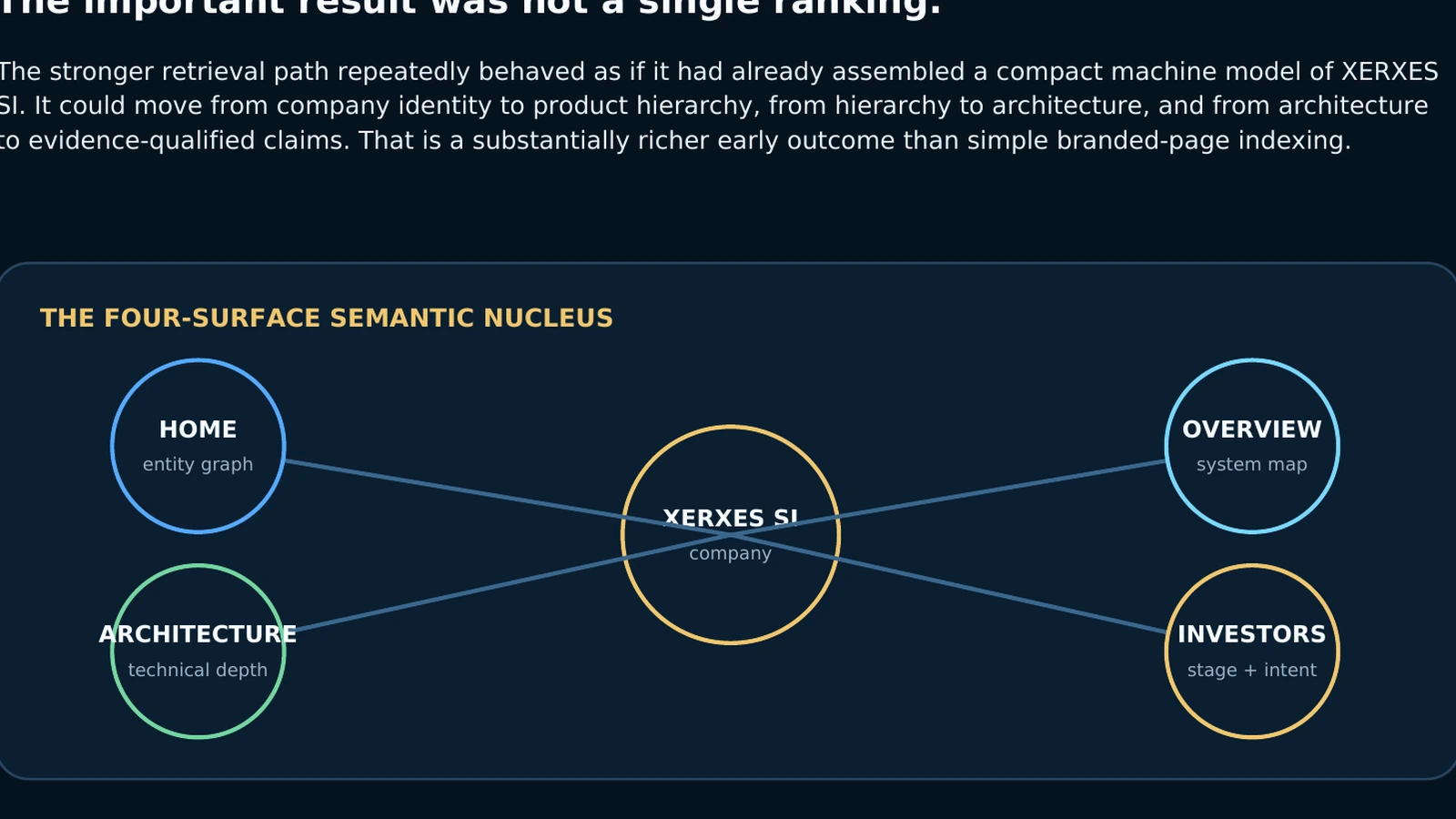
The source emphasizes that the important result was not a single ranking. It interprets the retrieval behavior as a compact machine model able to move from company identity to product hierarchy, architecture and evidence-qualified claims.
Four-surface semantic nucleus
Source-derived crop from page 2 of the Data Points Proof of Concept PDF.
A crawler can discover a page without understanding a system. The benchmark’s stronger signal was repeated cross-page agreement on entity roles.
Early semantic formation arrived fast
SOURCE MAPPDF p. 3The report observed same-day semantic formation while using Google’s public crawling/indexing documentation only as a cautious reference window—not as a promised baseline.
Homepage + investor recognition
Four-page nucleus recovered
Same nucleus; deeper passages
Architecture + evidence nuance
The publication deliberately describes the observation as faster-than-expected early semantic formation rather than claiming an industry-wide guaranteed multiplier.
The machines retrieved architecture, not just branding
SOURCE MAPPDF p. 4The strongest positive signal was depth: retrieval exposed technical concepts normally far below the level of a homepage snippet.
- Recursive triadic cognition — 3 → 9 → 27 → 81 organization and adaptive recruitment.
- Ordered Instruction IR — typed cognitive operations with ordering, dependencies, parameters, provenance, ownership and completion state.
- Synthetic-neuron role recruitment — stable identity with temporary planner, verifier, critic, mediator, retriever, router and error-monitor roles.
- Model authority separation — external models may contribute alternatives while truth, evidence, memory, action and final-answer authority remain elsewhere.
- Capability governance — ownership, qualification evidence, provenance, dependencies, decline boundaries and fallback discipline.
- Evidence qualification — measured results retrieved with scope limits rather than flattened into universal claims.
The report connects this observation to Google’s public description of passage ranking and RankBrain while keeping the XERXES result explicitly first-party.
A machine-readable product graph emerged
SOURCE MAPPDF p. 5Multiple first-party surfaces converged on the same hierarchy, increasing confidence that retrieval systems were reconstructing relationships rather than memorizing isolated strings.
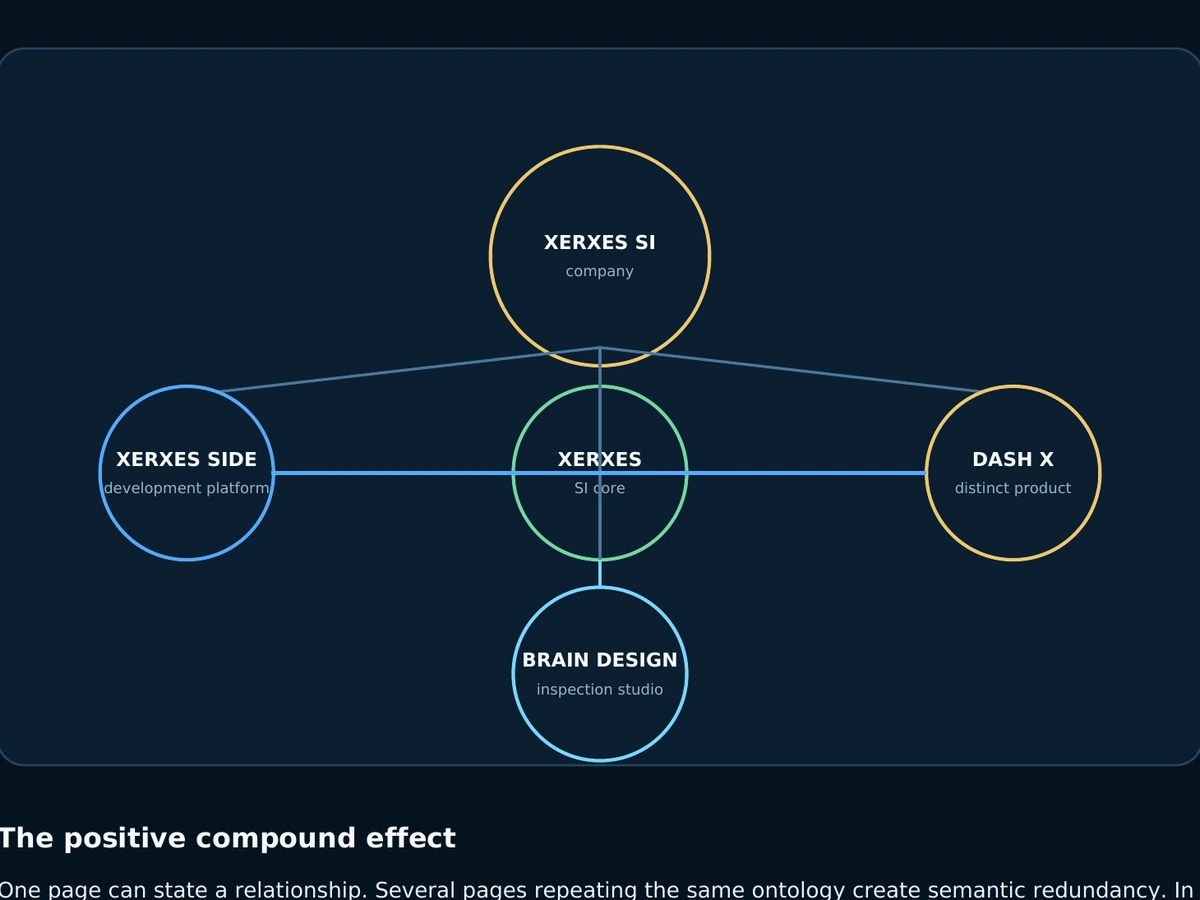
Machine-readable product graph
Source-derived crop from page 5 of the Data Points Proof of Concept PDF.
The graph represented XERXES SI as the company, XERXES SIDE as the development platform, XERXES as the SI core, Dash X as a distinct product, and Brain Design as the inspection studio.
The structure should teach the machine. The early result supports that thesis: explicit relationships across multiple pages formed a coherent system picture without reducing the company to one keyword.
Where the order-of-magnitude claim is measurable
SOURCE MAPPDF p. 6The report reserves order-of-magnitude language for the architecture experiment where the numerical controls make the comparison explicit.
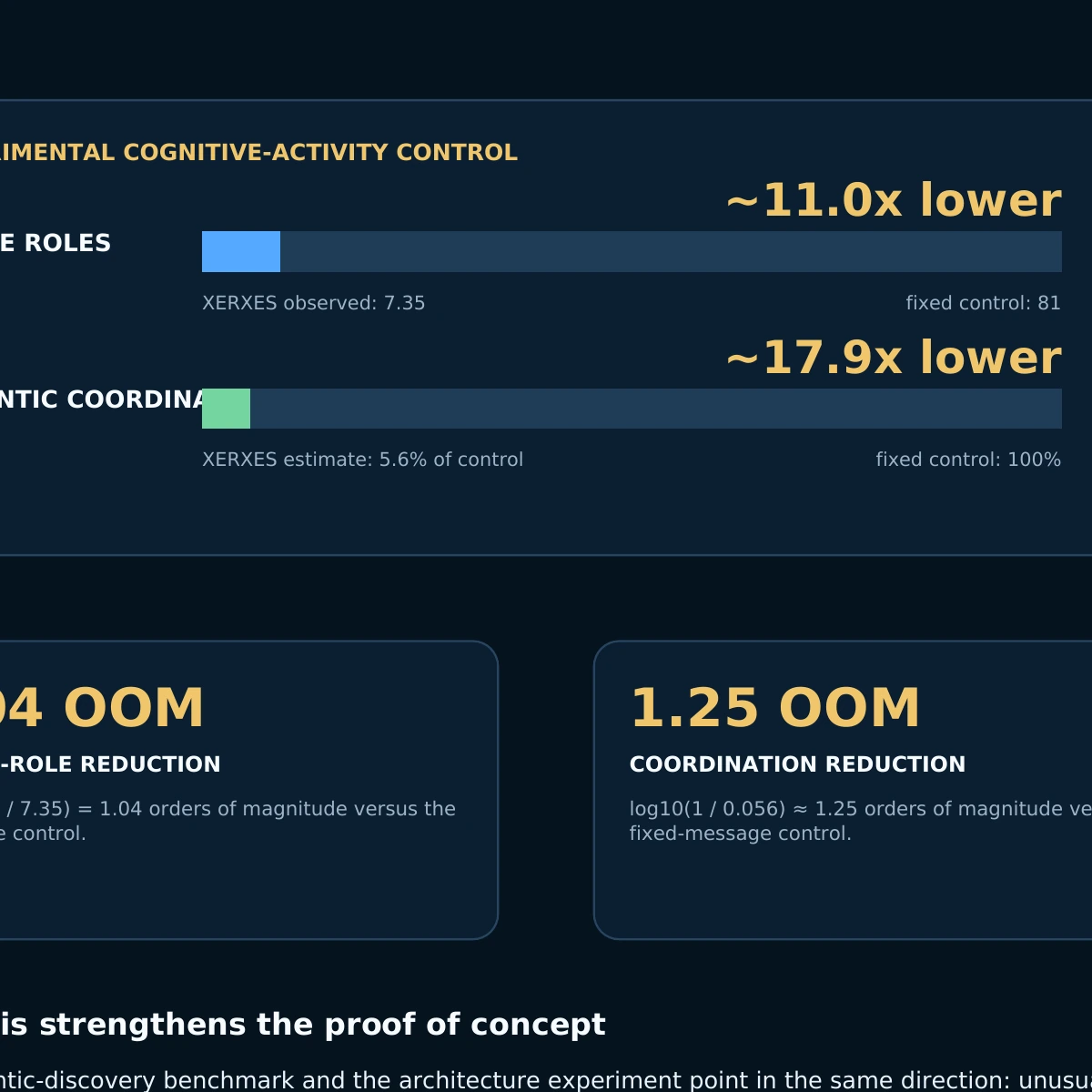
Experimental cognitive-activity controls
Source-derived crop from page 6 of the Data Points Proof of Concept PDF.
log10(81 / 7.35) = 1.04 OOMlog10(1 / 0.056) ≈ 1.25 OOM| Measure | XERXES observation | Fixed control | Reported reduction |
|---|---|---|---|
| Active roles | 7.35 | 81 | ~11.0x lower / 1.04 OOM |
| Semantic coordination messages | 5.6% of control | 100% | ~17.9x lower / 1.25 OOM |
These are first-party experimental control comparisons, not universal efficiency claims and not a universal SEO baseline.
A positive-only founder performance index
SOURCE MAPPDF p. 7The internal proof-of-concept index records whether each early expectation was met, exceeded, or materially exceeded by the observed benchmark.
| Expectation | Result | Evidence |
|---|---|---|
| Branded entity resolves when anchored | EXCEEDED | Four-page semantic nucleus repeatedly recovered. |
| Company/product hierarchy is reconstructable | EXCEEDED | Multiple pages converge on one ontology. |
| Architecture is understood beyond marketing | MATERIALLY EXCEEDED | Deep concepts and evidence qualifiers surfaced at passage level. |
| Investor intent is independently recognizable | MET + EXCEEDED | Investor surface and development-stage framing repeatedly retrieved. |
| Evidence status survives retrieval | EXCEEDED | Measured results appeared with scope qualifications. |
| Hourly protocol detects longitudinal change | MET | The 120-question battery is operating as a repeatable measurement instrument. |
The source concludes that the first-day benchmark supports the founder’s prediction that explicit semantic structure, modular relationships, evidence-aware prose and machine-readable hierarchy would enable unusually early reconstruction of significant parts of the XERXES SI architecture and organizational graph.
What this proof of concept actually measures
SOURCE MAPPDF p. 8A positive performance report can still be rigorous when benchmark observations and external context remain distinguishable.
| Method element | Definition |
|---|---|
| Benchmark design | 120 exact intents spanning identity, typos, architecture, LLM differentiation, product graph, investment, epistemic status, Lattice, relationship traversal, generic category discovery, adversarial prompts and public-source authority. |
| Observation model | Ambient/unquoted discovery and entity-anchored retrieval are tracked separately. |
| Positive signals | Four-surface recovery, deep architecture passage extraction, consistent product hierarchy, investor-stage understanding, claim-status preservation, same-day freshness and stability across checkpoints. |
| OOM standard | Order-of-magnitude language is used only where a numerical ratio supports it. |
Ask Google to recrawl your URLs
Google says crawling can take from a few days to a few weeks and requesting a crawl does not guarantee immediate inclusion.
OPEN SOURCE ↗GOOGLE SEARCH CENTRALdevelopers.google.comTroubleshoot Google Search crawling errors
Google notes that most sites should not expect same-day crawling and that indexing updates commonly take three days or more.
OPEN SOURCE ↗GOOGLE SEARCH CENTRALdevelopers.google.comA guide to Google Search ranking systems
Google documents passage ranking and RankBrain as systems for understanding relevant passages and relationships between words and concepts.
OPEN SOURCE ↗GOOGLE SEARCH CENTRALdevelopers.google.comHow Google Search works
Google describes crawling, indexing and serving as distinct stages of Search.
OPEN SOURCE ↗Keep exploring // human pathways
Continue through adjacent ideas, products, principles, and historical lineages. These pathways preserve the relationships in the underlying knowledge graph while keeping exploration natural for a human reader.
A governed, human-first and machine-readable knowledge system: stable modular objects become visual articles, Markdown, JSON-LD, search, source bridges, media registries, sitemaps, and navigable relations without duplicating the truth by hand.
CONTINUE →collectionFounder PublicationsThe complete eight-publication founder corpus: source-preserved essays, research monographs, and benchmark reports published as canonical human articles with governed fragments, provenance, affective context, media, and machine-readable representations.
CONTINUE → entityThe Founder
A privacy-preserving founder profile focused on technical lineage, systems literacy, operating philosophy, cross-domain study, and the design principles visible in XERXES SI—without publishing age, identity, or unnecessary personal detail.
CONTINUE →entityXERXES SIXERXES SI is the company entity connecting the public product, architecture, demonstration, evidence, investor, and knowledge properties.
CONTINUE →