
The Experts Who Would Have Stopped The Machine
Why Working Systems Outrank Consensus - and What I Want From People Who Challenge XERXES
Source document // the argument begins
SOURCE MAPPDF p. 2I have heard the word impossible too many times from people who never ran the experiment.
The pattern is remarkably consistent. A problem crosses disciplinary boundaries. Someone trained inside one boundary explains why the part outside that boundary is unrealistic. Another person explains why integration will be too difficult. Someone else says the architecture is unconventional. Then a committee forms around the accumulated reasons not to try.
That process is often called expertise.
Sometimes it is expertise. Sometimes it is merely inherited caution with credentials attached.
I do not reject experts. I reject the idea that expertise grants a veto over observation.
The machine either runs or it does not.
The test either passes or it does not.
The predicted behavior appears or it does not.
Reality is the final reviewer.
1. What “Impossible” Usually Means
SOURCE MAPPDF p. 2There are several very different statements that people collapse into the word impossible.
No one has demonstrated this.
I do not know how to build this.
Our organization would not approve this.
The conventional architecture does not support this easily.
The economics are unattractive under our assumptions.
The theory is incomplete.
I think the integration cost is too high.
I cannot imagine a pathway from here to there.
None of those statements means the same thing as:
The proposed behavior contradicts mathematics, physics, or a demonstrated constraint.
That distinction has shaped the way I build.
When someone says a design cannot work, I want the constraint. Show me the invariant. Show me the contradiction. Show me the measurement. Show me the theorem. Show me the failed implementation and explain why the failure generalizes.
If the objection cannot be reduced to something testable, I treat it as information - not authority.
2. Expertise Is An Input, Not A Throne
SOURCE MAPPDF pp. 2–3Domain expertise is enormously valuable. A good expert can save years. They know where previous systems failed, what assumptions are dangerous, what edge cases have destroyed otherwise elegant designs, and what evidence a serious field will demand.
But expertise has a failure mode: local optimization of thought.
A person can become extremely good at navigating the assumptions of a mature field and gradually stop noticing which assumptions are historical artifacts rather than laws of nature.
That problem becomes acute when a project crosses many fields.
Computer architecture sees one constraint.
Networking sees another.
Cognitive science frames the problem differently.
Software engineering imposes operational realities.
Biology contributes models that may be useful without being copied literally.
Law teaches a different discipline of evidence, contradiction, record preservation, and adversarial reasoning.
The interesting solution may exist between those vocabularies.
A committee of specialists can therefore be less capable than an integrator if every specialist is allowed to veto the parts that do not resemble the conventions of their own field.
3. I Test Before I Ask Permission From Consensus
SOURCE MAPPDF p. 3The practical philosophy behind XERXES has been straightforward:
Reduce the idea to mechanisms.
State what should happen if those mechanisms are correct.
Build the smallest useful implementation.
Test it.
Inspect the failure modes.
Revise the architecture.
Repeat.
That workflow has repeatedly produced a result that matters more to me than the original argument: something predicted actually happens in the running system.
At that point the discussion changes.
Before the experiment, a skeptic can say, “That will not work.”
After the experiment works, the skeptic must ask a different question:
“What exactly happened, and why?”
That transition - from permission to explanation - is where progress begins.
4. Working Does Not Mean Finished
SOURCE MAPPDF pp. 3–4There is an equally dangerous mistake on the other side.
A working prototype does not prove every theory surrounding it. A successful demonstration does not establish commercial dominance. A local benchmark does not establish universal superiority. An architecture that performs beautifully under one workload may fail badly under another.
I care about those distinctions because exaggeration destroys the very epistemic advantage I am trying to create.
When I say something worked, I want the record to show exactly what worked.
When I say something is measured, I want the methodology.
When I say something is architectural, I want the mechanism.
When I say something is a hypothesis, I want it labeled as a hypothesis.
Confidence is useful only when it remains attached to reality.
5. What Counts As Competition
SOURCE MAPPDF p. 4I also reject competition by category label.
Two systems are not necessarily competitors because both are called “AI.” Two companies are not direct peers because an analyst puts them in the same market slide.
Competition should be defined by capability under meaningful constraints.
If the requirement is persistent structured state, inspectable reasoning pathways, deterministic control where required, explicit internal organization, low-resource execution, and optional rather than mandatory dependence on a large language model, then the relevant competitor is the system that satisfies those requirements.
If another system does not attempt the same problem, it may be commercially adjacent without being architecturally equivalent.
That is why I am careful with claims such as “there is no competition.” The useful version of that statement is testable:
Under a defined set of architectural requirements, identify another system that satisfies the same set.
If one exists, study it.
If several exist, compare them.
If none can be found, then the absence is meaningful - but it remains an empirical statement, not a slogan.
6. Why I Do Not Want A Board Of Prestige
SOURCE MAPPDF pp. 4–5This philosophy has direct implications for governance.
I do not want a board assembled as a museum of famous credentials.
A director's purpose is not to make the company look legitimate by association. A director should improve the probability that the organization sees reality clearly and acts intelligently.
That means I want people who can do at least one of the following exceptionally well:
identify hidden failure modes;
challenge assumptions with evidence;
understand markets and capital without reducing the technology to fashion;
protect the company legally and institutionally;
recognize technical leverage others miss;
force measurements when enthusiasm outruns evidence;
help turn a working architecture into a durable organization.
An expert who says “no” because the field has always said no is not protecting the company.
An expert who says “your result conflicts with this constraint, here is the evidence, and here is the test that will decide between us” is invaluable.
The difference is falsifiability.
I do not want agreement. I want high-quality opposition.
7. The Best Critic Is A Co-Designer Of The Test
SOURCE MAPPDF p. 5The strongest challenge to XERXES is not an opinion article.
It is a better experiment.
If someone believes a capability is an artifact, design the control.
If someone believes a benchmark is misleading, propose a stronger benchmark.
If someone believes an architectural distinction is superficial, specify the criterion that would reveal equivalence.
If someone believes a result will not generalize, define the workload that should break it.
This turns criticism into engineering.
That is what I want from serious experts.
The person who helps design the experiment that could prove me wrong contributes more to XERXES than the person who praises it without understanding it.
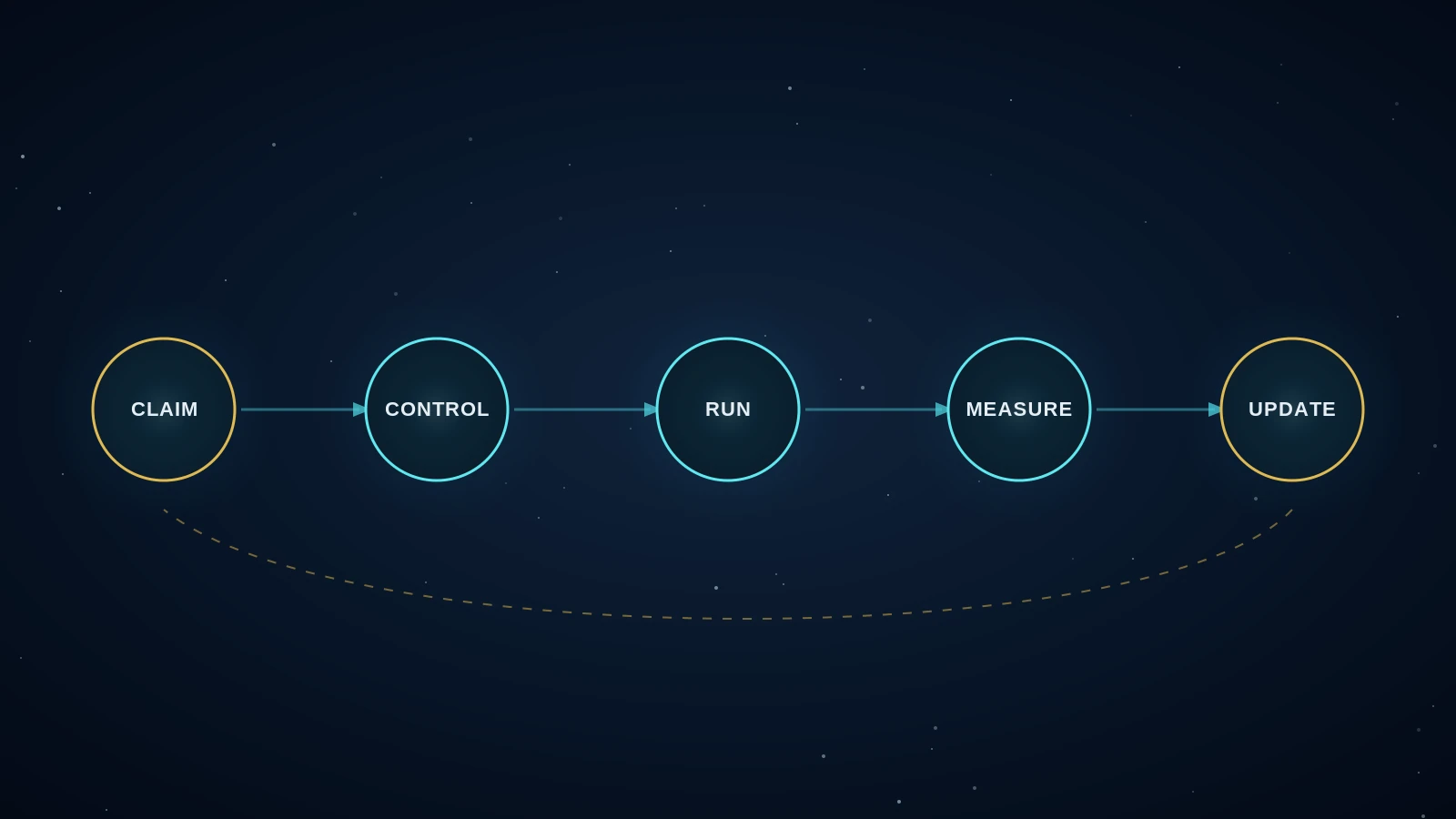
Criticism converted into an experiment
Editorial test loop for the essay’s central governance principle: claims improve when critics help design the experiment that could defeat them.
8. Why The Lattice Exists Beside The Machine
SOURCE MAPPDF p. 5This is also why the Lattice exists.
A working system can be misunderstood almost as easily as an unbuilt idea if the record around it is poor.
So the knowledge system must preserve:
what was predicted;
what was implemented;
what was observed;
what changed;
what failed;
what remains uncertain;
what evidence supports each conclusion;
and which interpretation is merely commentary.
That makes the public record adversarially useful.
An intelligent critic can inspect it.
A search system can reconstruct it.
An investor can distinguish architecture from aspiration.
An engineer can identify the next test.
The purpose is not to make criticism impossible.
The purpose is to make lazy criticism obsolete.
9. The Standard For Authority
SOURCE MAPPDF pp. 5–6I have no objection to authority earned through repeated contact with reality.
I object to authority that survives after reality contradicts it.
If someone predicted a system could not work and the system works, their credentials do not disappear. Their model simply needs revision.
That is science at its best.
The correct response to an unexpected working system is curiosity, not embarrassment.
What assumption was wrong?
What constraint was bypassed?
What new tradeoff was introduced?
What does this result not prove?
What should we test next?
Those questions move knowledge forward.
10. Build The Board That Can Survive Being Wrong
SOURCE MAPPDF p. 6The people around XERXES should therefore possess a quality more important than prestige: the ability to update.
I want directors, advisers, engineers, scientists, attorneys, operators, and investors who can say:
“I believed X. The evidence now supports Y. I have changed my mind.”
That sentence is a sign of strength.
The organization that cannot say it becomes a bureaucracy around yesterday's assumptions.
XERXES exists because I was willing to test assumptions that other people treated as settled. If I build a governance structure that later prevents the same behavior, I will have recreated the problem I escaped.
So no, I do not want experts merely because they are experts.
I want people whose expertise survives contact with evidence.
I want critics who can build tests.
I want directors who understand that consensus is provisional.
I want engineers who distinguish convention from constraint.
I want investors capable of recognizing a result before everyone else agrees that it matters.
And I want every one of them to be willing to tell me when the machine proves me wrong.
Because that is the standard I apply to everyone else.
The machine does not care who won the argument.
It only cares whether the logic executes.
*The Founder*
Keep exploring // human pathways
Continue through adjacent ideas, products, principles, and historical lineages. These pathways preserve the relationships in the underlying knowledge graph while keeping exploration natural for a human reader.
The complete eight-publication founder corpus: source-preserved essays, research monographs, and benchmark reports published as canonical human articles with governed fragments, provenance, affective context, media, and machine-readable representations.
CONTINUE → entityThe Founder
A privacy-preserving founder profile focused on technical lineage, systems literacy, operating philosophy, cross-domain study, and the design principles visible in XERXES SI—without publishing age, identity, or unnecessary personal detail.
CONTINUE →productXERXESXERXES is the Synthetic Intelligence core: an inspectable cognitive architecture organized around structured synthetic neurons, explicit system state, and modular reasoning behavior.
CONTINUE →entityXERXES SIXERXES SI is the company entity connecting the public product, architecture, demonstration, evidence, investor, and knowledge properties.
CONTINUE →