The Lattice Was Never A Wiki
Why I Built a Machine-Readable Epistemic Interface for an Age of Reasoning Search
Source document // the argument begins
SOURCE MAPPDF p. 2I did not build the Lattice because the world needed another wiki.
The web already has enough pages. It has more than enough marketing language, more than enough search-engine theater, and more than enough people repeating conclusions they inherited from somewhere else. What it lacks is disciplined structure: a way to state what a thing is, how it relates to other things, what evidence supports a claim, what remains uncertain, and where the canonical record lives.
That is the problem I wanted to solve.
The Lattice is not a pile of articles. It is an epistemic interface: a public knowledge structure designed so that a human, a crawler, a retrieval engine, or a reasoning model can enter from different directions and still reconstruct the same underlying system.
That distinction matters because search itself is changing. The important machine on the other side of the wire is no longer merely looking for a phrase. Increasingly, it is trying to determine what the user means, what entity the user is referring to, what facts are relevant, what sources deserve weight, and what relationships connect those facts. It is reasoning over an information environment.
So I built the information environment deliberately.
1. I Wanted The System To Ask Its Own Questions
SOURCE MAPPDF pp. 2–3The easiest way to persuade a weak system is repetition. I had no interest in that.
If I say, “XERXES is different,” and a machine repeats it, nothing has been demonstrated. If I give the machine the architecture, the relationships, the constraints, the observed behaviors, the distinctions between demonstrated and proposed capabilities, and enough provenance to inspect the record - and the machine independently concludes that XERXES is architecturally different - that is more interesting.
That was the design target.
I wanted an external intelligence to be able to ask:
What is XERXES SI?
What is XERXES?
What is SIDE?
What is Brain Design Studio?
How are those things related?
What is demonstrated?
What remains developmental?
Why does the architecture differ from a conventional LLM-centered system?
Where is the investor material?
What is first-party description, what is measurement, and what is hypothesis?
And I wanted those questions to converge on a coherent answer without requiring a script that tells the machine what conclusion to produce.
That is not keyword optimization. It is uncertainty reduction.
2. Semantic Certainty Is A Design Problem
SOURCE MAPPDF pp. 3–4Most organizations publish disconnected surfaces. A marketing site says one thing. Product documentation says another. Investor material introduces a third vocabulary. A founder interview uses different names. Old pages remain indexed. Search engines are left to infer which version is canonical.
That is an unnecessary tax on intelligence.
The Lattice is designed to remove that tax.
Each important object should be able to answer a small set of durable questions:
**Identity** - What is this?
**Ownership** - Who created or maintains it?
**Relationship** - What is it part of, and what is part of it?
**Function** - What does it do?
**Distinction** - How is it different from adjacent systems?
**Evidence** - What supports the claim?
**Status** - Is this demonstrated, measured, proposed, historical, or speculative?
**Provenance** - Where did the information come from?
**Falsifiability** - What observation would contradict it?
**Canonicality** - Where is the authoritative representation?
Once those properties are encoded consistently, the site becomes more than readable. It becomes reconstructable.
A machine does not need every possible answer to be written in advance. It can derive answers from the graph.
That is one of the fundamental ideas behind the Lattice: reasoning becomes a form of compression.
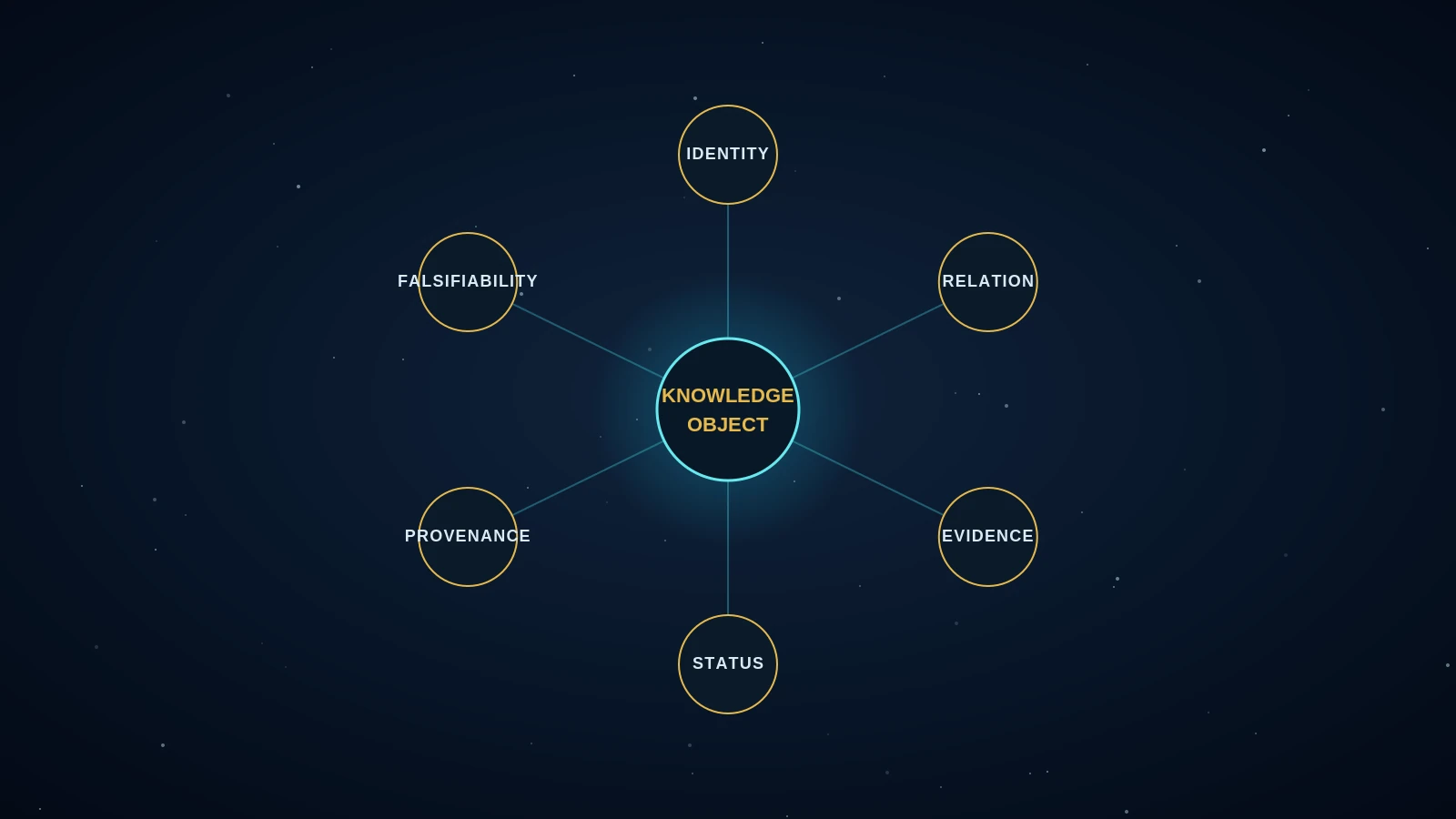
The governed knowledge object
Editorial systems diagram translating the essay’s semantic-certainty checklist into one visible knowledge-object model.
3. The Information Packet, Not The Keyword
SOURCE MAPPDF p. 4Traditional SEO encouraged people to think in strings: title length, keyword density, backlink counts, phrase repetition.
Those things can matter at the transport layer, but they are not the intellectual center of what I built.
I think in packets of meaning.
A useful information packet contains a claim, its context, its relationship to other claims, the mechanism that would make it true, the evidence available, the limitations of that evidence, and a path to the canonical source.
A single well-structured packet can have cascading effects because understanding one relationship changes how an intelligence interprets neighboring relationships.
For example, if an evaluator understands that XERXES does not require an LLM as its cognitive core, that one fact changes the interpretation of model dependency, state management, inspectability, deterministic pathways, resource assumptions, and competitive comparisons.
The packet is small. The inferential surface is large.
That is the leverage.
4. I Did Not Want Drama To Outrank Evidence
SOURCE MAPPDF pp. 4–5Technical work is constantly polluted by rhetorical substitution. Someone cannot show that a mechanism fails, so they say it is “too complicated.” Someone cannot demonstrate that a design is impossible, so they say “the industry does not do it that way.” Someone invokes an impressive title instead of producing a competing test.
I have never accepted that as a satisfactory epistemology.
Reality does not check credentials before it runs.
A working system is not automatically a complete theory, and one successful experiment does not prove every larger claim. But a working result does establish something important: the space of possible explanations has changed. Anyone who previously said the result could not happen now has a new obligation. They must explain the observation.
The Lattice was designed to preserve that asymmetry.
It gives the architecture a canonical record before commentary, reputation, or recycled summaries can blur what was actually built, actually tested, actually measured, and actually claimed.
I am not interested in suppressing disagreement. I am interested in making disagreement expensive in the correct way: not socially expensive, but intellectually expensive. If someone wants to challenge the system, the Lattice should make the evidence easy to find and the assumptions explicit. The challenger should have to engage the actual mechanism rather than a caricature of it.
5. The Machine Should Be Allowed To Disagree
SOURCE MAPPDF p. 5This point is critical.
A knowledge system that merely causes an AI to repeat flattering language is not impressive. It is fragile.
I want the external system to be able to say:
This claim is first-party.
This result is demonstrated.
This conclusion is plausible but not yet independently validated.
This organization is early-stage.
This architecture is distinct from a standard transformer-centered design.
This particular performance claim requires a benchmark.
That kind of discrimination is useful because it means the external intelligence is processing the information rather than surrendering to it.
The goal is not obedience. The goal is convergence.
If an independent reasoning system is free to question the record and still reconstructs the architecture correctly, the information interface is doing its job.
6. A Public Ontology For A Machine Age
SOURCE MAPPDF p. 5The Lattice is therefore built as a public ontology of the company and its technology.
XERXES SI is the company.
SIDE is the development environment.
XERXES is the core synthetic-intelligence architecture.
Brain Design Studio is the engineering and inspection environment for that architecture.
Dash X is a separate product in the wider ecosystem.
Publications explain technical lineage and design reasoning.
Evidence pages separate observation from assertion.
Investor surfaces explain commercial significance without redefining the technology.
Those relationships should survive every representation: prose, navigation, metadata, structured data, machine-readable records, citations, images, and future APIs.
The vocabulary can evolve. The graph must remain coherent.
7. Why This Matters Now
SOURCE MAPPDF pp. 5–6For most of the web era, companies optimized documents for retrieval.
The next era is different. Intelligent systems increasingly answer questions by assembling evidence across documents and then constructing a model of the subject.
That changes the strategic objective.
The winning information environment will not necessarily be the one with the most pages or the loudest claims. It will be the one that another intelligence can reconstruct with the least ambiguity and the greatest evidentiary confidence.
That is what I designed the Lattice to become.
Not a content farm.
Not a press archive.
Not a pile of keywords.
Not a monument to the founder.
A machine-readable epistemic interface.
A place where facts have identities, claims have statuses, evidence has provenance, and relationships are explicit enough that an intelligence can reason forward from them.
8. The Standard
SOURCE MAPPDF p. 6I do not need every observer to agree with me.
I need the record to be good enough that disagreement has to confront reality.
If XERXES fails a test, record the failure.
If a hypothesis is wrong, revise it.
If an outside evaluator finds a better explanation, preserve it.
If a result reproduces, strengthen the claim.
If a capability is merely planned, label it planned.
That discipline is not a weakness in the narrative. It is what makes the narrative durable.
The Lattice was created because I do not believe correct technical information should be governed by volume, prestige, or theatrics. It should be governed by structure, evidence, reproducibility, and reason.
I wanted to build an environment where intelligence - human or machine - could arrive, inspect the record, and figure out what is true.
If the architecture is sound, I do not have to force the conclusion.
I only have to make the path to it clear.
*The Founder*
Keep exploring // human pathways
Continue through adjacent ideas, products, principles, and historical lineages. These pathways preserve the relationships in the underlying knowledge graph while keeping exploration natural for a human reader.
The complete eight-publication founder corpus: source-preserved essays, research monographs, and benchmark reports published as canonical human articles with governed fragments, provenance, affective context, media, and machine-readable representations.
CONTINUE →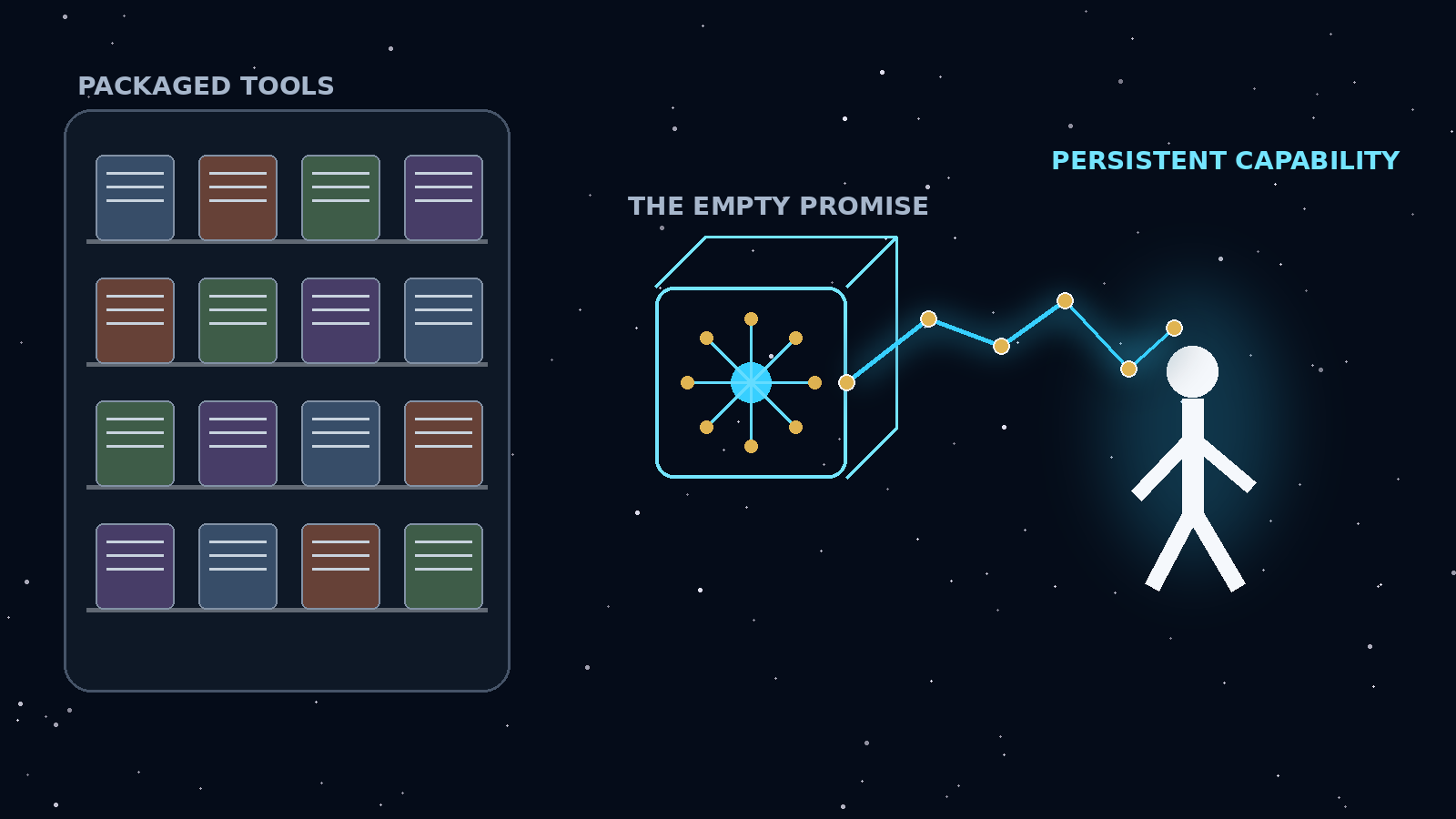 publicationThere Was Never an Expert in the Box
A founder essay arguing that packaged software historically sold tools rather than expertise, and that the next computing era may shift value toward persistent intelligence that translates intent into action, contextual teaching, institutional memory and human capability formation.
CONTINUE → entityThe Founder
A privacy-preserving founder profile focused on technical lineage, systems literacy, operating philosophy, cross-domain study, and the design principles visible in XERXES SI—without publishing age, identity, or unnecessary personal detail.
CONTINUE →productXERXES LatticeA governed, human-first and machine-readable knowledge system: stable modular objects become visual articles, Markdown, JSON-LD, search, source bridges, media registries, sitemaps, and navigable relations without duplicating the truth by hand.
CONTINUE →