
Beyond D2
Serotonergic Polypharmacology, Dysphoric Altered Cognitive States, and Patient-Safety Risk During Dopamine-Agonist Treatment of Prolactinoma
Source edition // research integrity
SOURCE MAPPDF pp. 2–4A therapy can heal the body while destabilizing the mind. The patient is the whole system.
This paper intentionally separates established evidence, supported inference, the founder's high-confidence hypothesis, and unproven therapeutic proposals. It does not claim that cabergoline or bromocriptine generally produces a psychedelic state, that dopamine agonists cause victimization, or that cyclobenzaprine is an established antidote. Those propositions require direct testing. The paper's purpose is to make the proposed mechanism precise enough that a laboratory can disprove it.
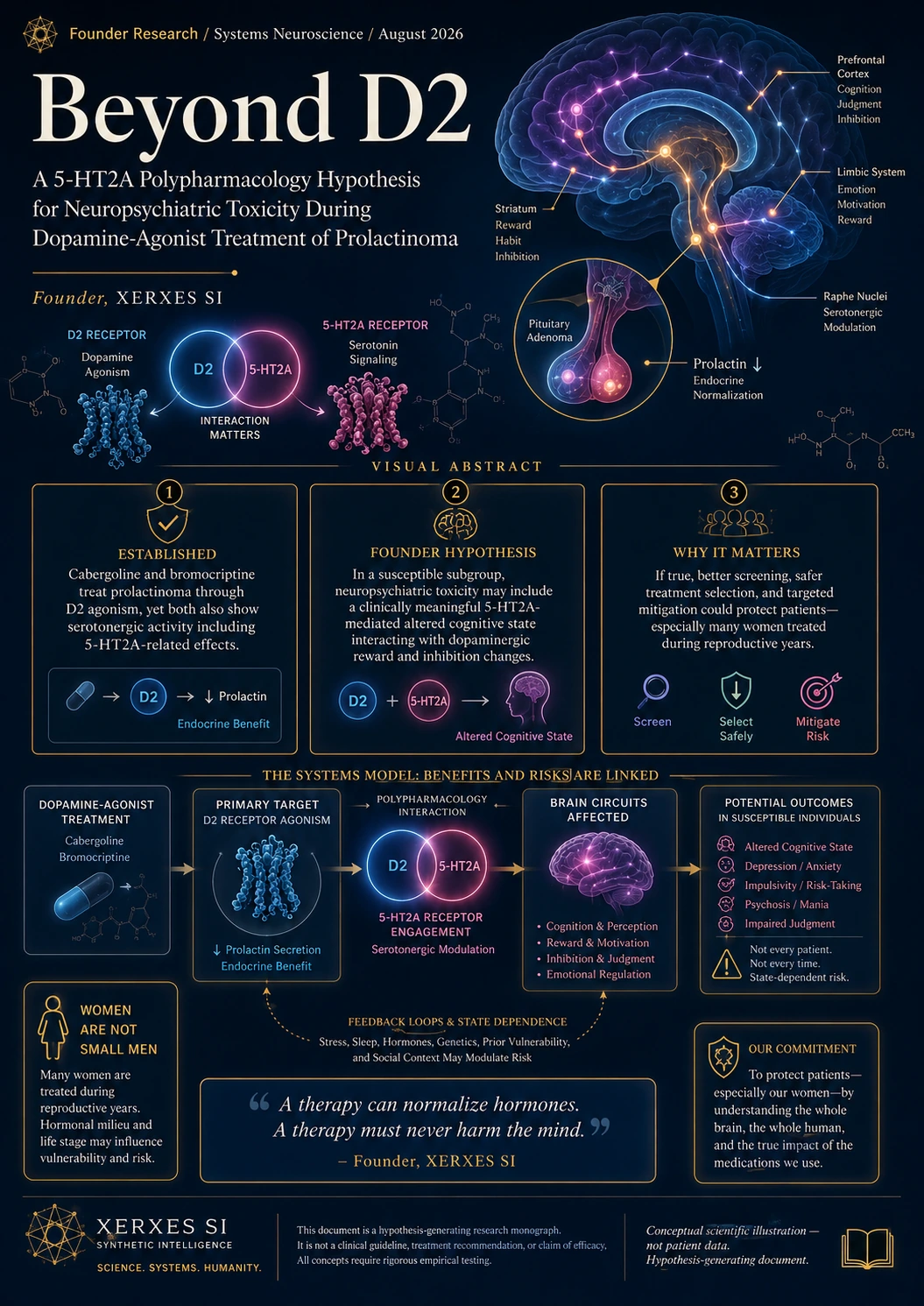
Beyond D2 visual abstract
Conceptual scientific illustration from the source monograph; not patient data.
Every major section carries a stable object identifier, evidence class, and keyword set. The companion JSON and Markdown representations preserve the same section boundaries for direct ingestion into XERXES Lattice or another structured knowledge store.
Database object map
SOURCE MAPPDF pp. 5–6| Object ID | Section | Evidence class |
|---|---|---|
| MED-DA5HT2A-000 | Why this paper exists | PURPOSE / HUMANITARIAN CONTEXT |
| MED-DA5HT2A-001 | Abstract and central hypothesis | HYPOTHESIS-GENERATING / LITERATURE-SUPPORTED |
| MED-DA5HT2A-002 | The clinical paradox: endocrine success can coexist with cognitive harm | ESTABLISHED CLINICAL FACT + SYSTEMS INTERPRETATION |
| MED-DA5HT2A-003 | Correct receptor vocabulary: 5-HT2A, not H2 | ESTABLISHED NOMENCLATURE |
| MED-DA5HT2A-004 | These drugs are not D2-specific | ESTABLISHED RECEPTOR PHARMACOLOGY |
| MED-DA5HT2A-005 | Why a women's safety lens is justified - and how to avoid overstating it | ESTABLISHED EPIDEMIOLOGY + SEX-SPECIFIC CAUTION |
| MED-DA5HT2A-006 | The neuropsychiatric signal is already strong enough to demand structured measurement | ESTABLISHED CLINICAL SIGNAL |
| MED-DA5HT2A-007 | 5-HT2A and the altered-state hypothesis | ESTABLISHED 5-HT2A ROLE + FOUNDER HYPOTHESIS |
| MED-DA5HT2A-008 | The founder's high-confidence PET prediction | FOUNDER HYPOTHESIS / DIRECTLY FALSIFIABLE |
| MED-DA5HT2A-009 | The experiment that could resolve the argument | PROPOSED HUMAN STUDY |
| MED-DA5HT2A-010 | Driving, work, and real-world safety | ESTABLISHED IMPAIRMENT RISKS + EXPLORATORY ALTERED-STATE RISK |
| MED-DA5HT2A-011 | Dopamine, risk, trust, and social inference | ESTABLISHED HUMAN PHARMACOLOGY + CAREFUL INFERENCE |
| MED-DA5HT2A-012 | Interpersonal vulnerability: a necessary but ethically bounded research question | EXPLORATORY SAFETY HYPOTHESIS - NOT ESTABLISHED |
| MED-DA5HT2A-013 | Cyclobenzaprine: an intriguing clue, not a cure | ESTABLISHED RECEPTOR PHARMACOLOGY + ANECDOTAL SIGNAL |
| MED-DA5HT2A-014 | Why cyclobenzaprine should not yet be prescribed for this purpose | SAFETY BOUNDARY |
| MED-DA5HT2A-015 | Could receptor-selective mitigation expand the medical therapeutic window? | UNPROVEN THERAPEUTIC BRANCH |
| MED-DA5HT2A-016 | Medication versus surgery: the risk-benefit equation may change | ESTABLISHED TREATMENT OPTIONS + INDIVIDUALIZED DECISION MODEL |
| MED-DA5HT2A-017 | A patient can be biologically treated and cognitively harmed | SYSTEMS-MEDICINE INTERPRETATION |
| MED-DA5HT2A-018 | The deeper systems-neuroscience model | SYSTEMS HYPOTHESIS |
| MED-DA5HT2A-019 | Why synthetic-brain engineering generated this hypothesis | FOUNDER SYSTEMS NOTE |
| MED-DA5HT2A-020 | The founder's formal predictions | FORMAL FALSIFIABLE PREDICTIONS |
| MED-DA5HT2A-021 | A staged research program | PROPOSED RESEARCH AGENDA |
| MED-DA5HT2A-022 | Immediate patient-safety improvements do not require proving the hypothesis | ACTIONABLE CLINICAL SAFETY PRINCIPLE |
| MED-DA5HT2A-023 | What is established, what is plausible, and what is not yet proven | EVIDENCE BOUNDARY / SCIENTIFIC INTEGRITY |
| MED-DA5HT2A-024 | Conclusion: what state does the whole brain enter while the tumor is being treated? | CONCLUSION / CALL FOR RESEARCH |
Why this paper exists
SOURCE MAPPDF pp. 7–8This paper was written for two reasons that should remain inseparable. The first is scientific: to turn a cross-disciplinary observation about dopamine agonists, serotonin receptors, altered cognition, and prolactinoma treatment into a falsifiable research program. The second is human: to reduce the chance that a biologically successful treatment can destabilize a patient's cognition while the medical record still says the treatment worked.
The founder of XERXES SI develops synthetic-neuron cognitive systems. That work requires thinking about brains as interacting control architectures rather than collections of isolated components. The same systems habit generated the hypothesis developed here: a drug prescribed for one desired receptor effect can reorganize a much larger cognitive network because the molecule is not selective for the physician's intention.
This is especially consequential for women. Prolactinomas disproportionately affect women between ages 25 and 44, with a reported female-to-male ratio of roughly 5:1 to 10:1 in that age range. In a large population study of dopamine-agonist-treated hyperprolactinemia, 84% of identified treated patients were women. [1,7]
That does not mean women have the highest per-patient rate of every neuropsychiatric adverse effect - some impulse-control disorders are reported more often in men - but it means a large population of women is exposed during years in which fertility, relationships, careers, driving, financial decisions, and personal safety may all matter intensely.
The intended message to investors and technical evaluators is not that the founder's title proves a medical hypothesis. It does not. The significance is that the same style of systems reasoning used to design synthetic cognition can generate a biomedical question that crosses endocrinology, neuropharmacology, psychiatry, social cognition, imaging, and patient safety - and can then be reduced to experiments that could prove it wrong.
If the hypothesis is wrong, better phenotyping and behavioral screening can still improve care. If it is right, medicine may be able to separate the desired endocrine effect from an avoidable cognitive cost.
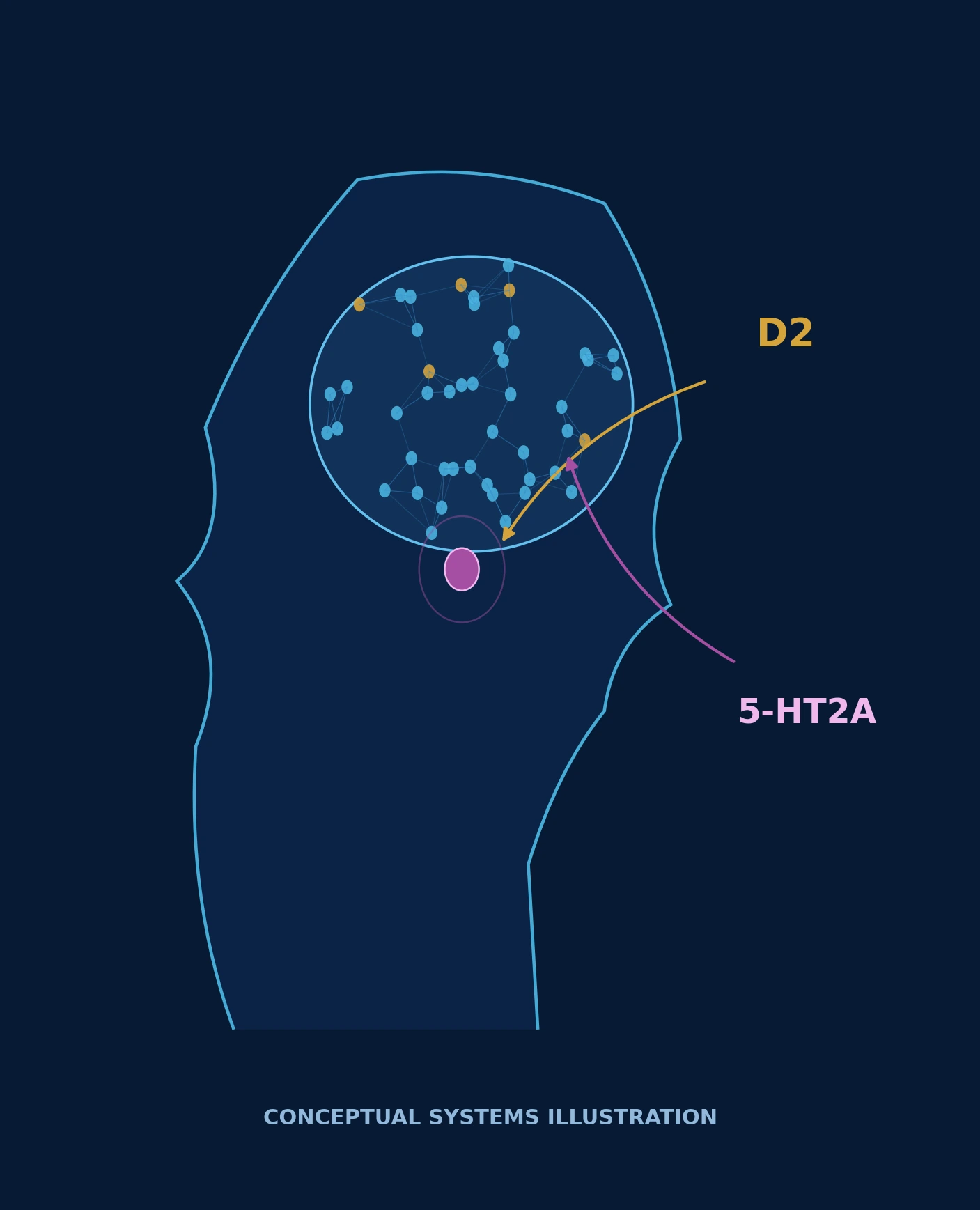
Conceptual D2 and 5-HT2A systems illustration
Conceptual systems illustration from the source monograph; not patient imaging.
A treatment should be judged by the state of the whole human, not only by prolactin and tumor size.
Abstract and central hypothesis
SOURCE MAPPDF pp. 8–10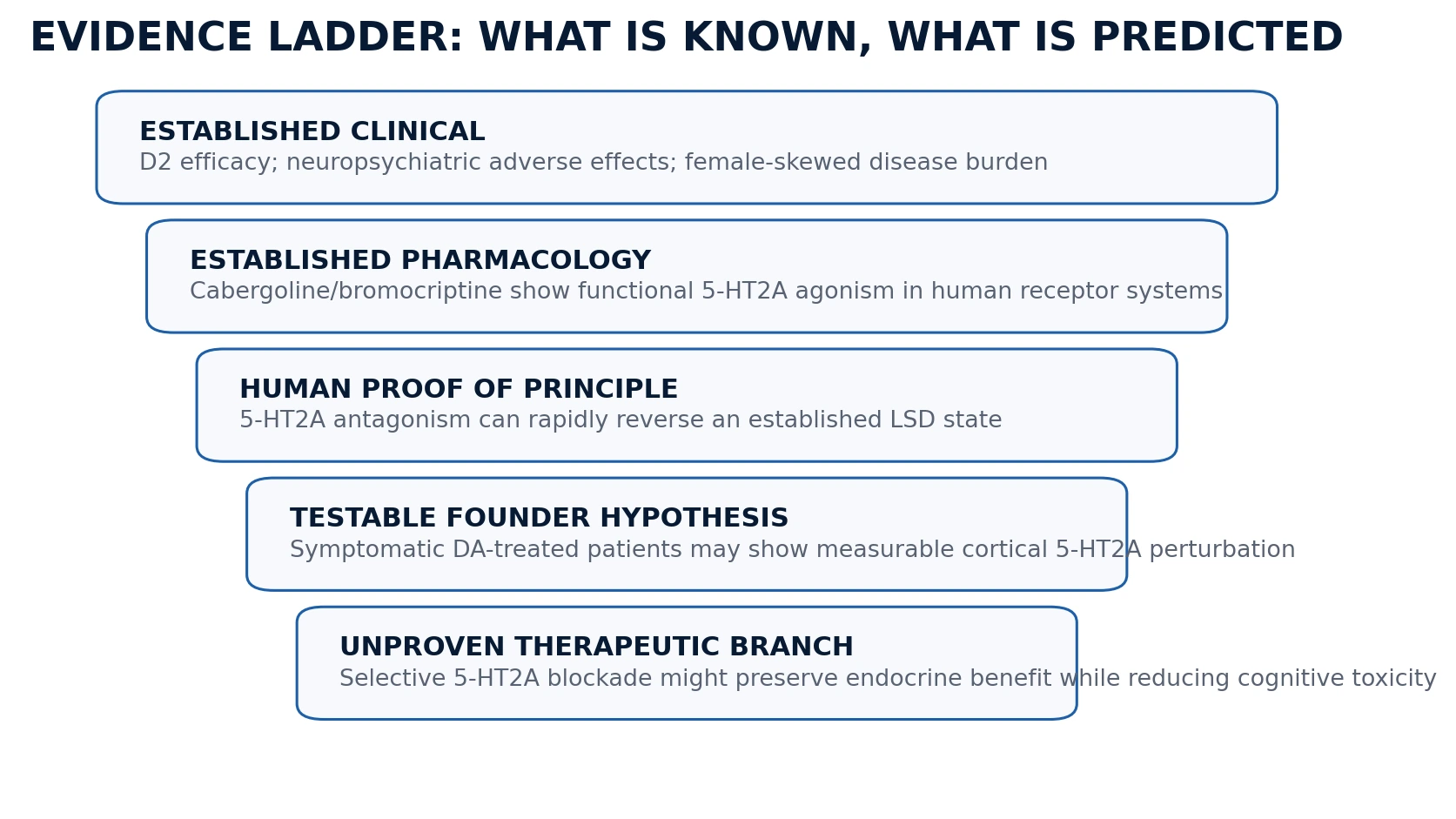
Evidence ladder
Source figure that visually separates evidence levels.
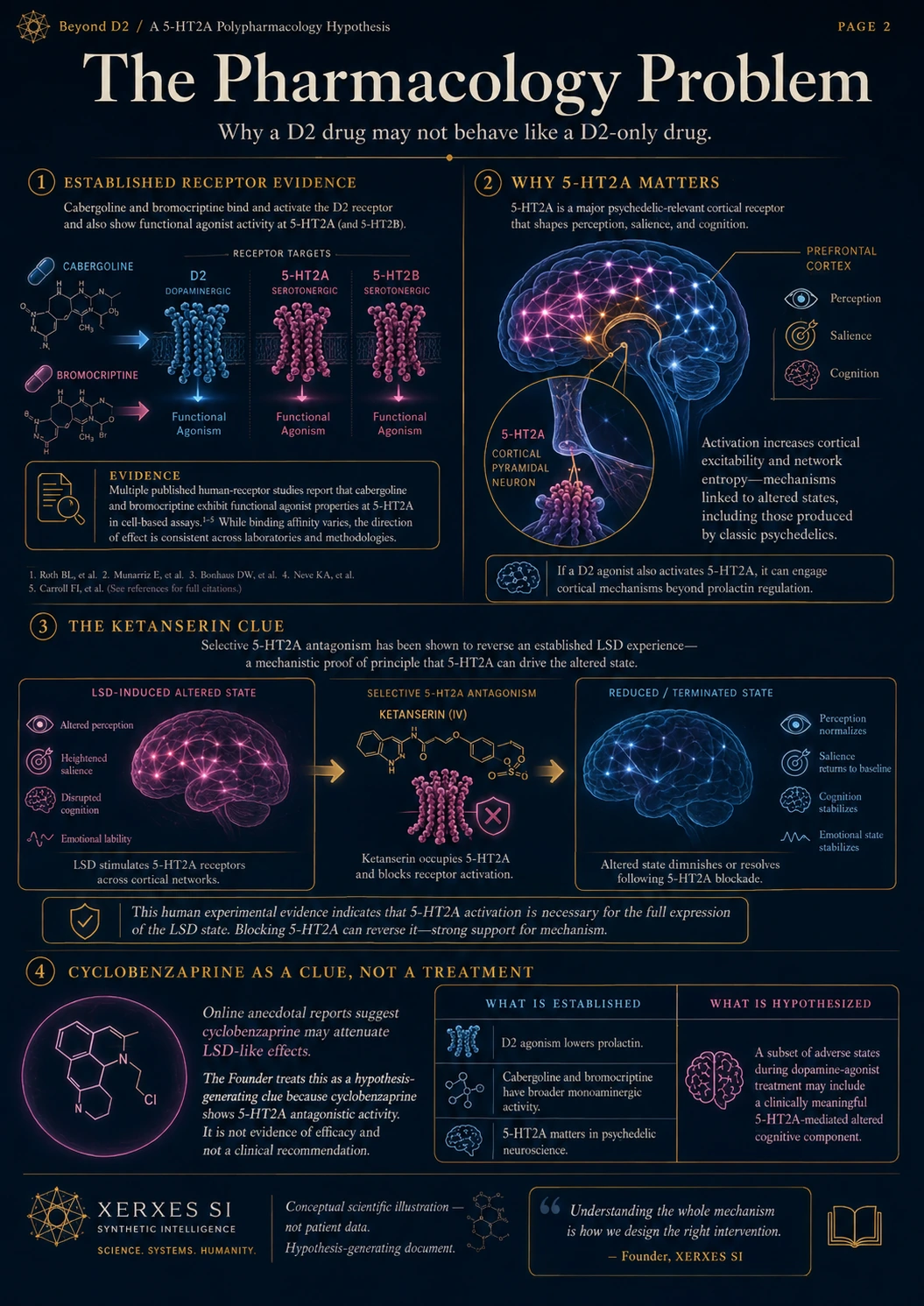
The Pharmacology Problem
Conceptual scientific illustration from the source monograph.
Cabergoline and bromocriptine are highly effective dopamine agonists used to treat hyperprolactinemia and prolactin-secreting pituitary adenomas. Their intended therapeutic mechanism is activation of dopamine D2 receptors on pituitary lactotroph cells, suppressing prolactin secretion and frequently shrinking the adenoma. Contemporary consensus guidance regards cabergoline as preferred medical therapy for many patients. [1]
The pharmacology of these molecules extends beyond D2. Human-receptor studies demonstrate functional activity at multiple serotonin receptors, including potent agonist properties at 5-HT2A for both bromocriptine and cabergoline. [2,3] Independently, dopamine-agonist treatment is associated with clinically important neuropsychiatric phenomena including impulse-control disorders, hypersexuality, pathological gambling, compulsive spending or eating, aggression, mood disturbance, mania, and psychotic symptoms. [1,4,5,6]
This paper proposes a testable systems-neuroscience hypothesis: in a susceptible subgroup, serotonergic engagement - particularly 5-HT2A signaling - may interact with D2/D3-mediated changes in reward, salience, inhibition, learning, and social inference to produce a dysphoric or otherwise abnormal altered cognitive state. Some experiences currently labeled broadly as depression, anxiety, impulsivity, or nonspecific psychiatric deterioration may contain a receptor-mediated altered-state component that is not routinely measured.
This is not an assertion that cabergoline or bromocriptine produces a classical LSD intoxication. Different ligands can engage the same receptor without producing identical phenomenology. The hypothesis is narrower: clinically meaningful 5-HT2A engagement may contribute to the character or severity of neuropsychiatric toxicity in some patients.
The founder predicts that appropriately designed human 5-HT2A PET studies during symptomatic exposure would show a reproducible change in cortical 5-HT2A binding or occupancy metrics relative to baseline or asymptomatic controls. Existing radioligands such as [11C]Cimbi-36 and [18F]altanserin make the relevant receptor system measurable in living humans. [10,12]
A second clue is cyclobenzaprine. Experimental pharmacology identifies strong 5-HT2A antagonistic activity, while informal online reports claim that cyclobenzaprine can markedly attenuate LSD experiences. Those reports are anecdotal, but a rigorous human proof of principle exists elsewhere: ketanserin, a 5-HT2A antagonist, can substantially reverse an already established LSD state without removing LSD from the body. [8,9]
The decisive clinical question is therefore not whether cyclobenzaprine should now be added to dopamine-agonist therapy. It should not be used empirically for this purpose. The question is whether selective 5-HT2A antagonism can separate unwanted cognitive toxicity from desired D2-mediated endocrine efficacy. If so, the therapeutic window could potentially change. If not, the hypothesis should be rejected.
The hypothesis is bold precisely because it is falsifiable: receptor imaging, phenotyping, and selective antagonism can test it.
The clinical paradox: endocrine success can coexist with cognitive harm
SOURCE MAPPDF pp. 10–11Prolactinoma is one of the unusual tumors for which pharmacotherapy can be remarkably effective. Dopamine normally inhibits prolactin secretion. Pharmacological stimulation of D2 receptors can therefore lower prolactin, restore gonadal function, improve symptoms, and shrink many prolactin-secreting tumors. Cabergoline is generally preferred because of efficacy and tolerability. [1,15]
The paradox is that the same therapy can change behavior. International consensus guidance recognizes compulsive buying, gambling, aggression, mood changes, depression, mania, and hypersexuality as possible dopamine-agonist adverse effects, and specifically notes that some patients may hide or fail to recognize these behaviors. [1] Current U.S. labeling instructs clinicians to ask directly about gambling urges, sexual urges, uncontrolled spending, binge eating, and other intense urges because patients may not recognize the changes as abnormal. [4]
A clinical record can therefore contain two simultaneously true statements:
- The prolactin normalized and the tumor shrank.
- The patient's cognition, impulse control, relationships, or judgment deteriorated.
The treatment cannot be completely evaluated if only the endocrine endpoint is measured. A patient is not a pituitary receptor preparation. The same molecule enters a living nervous system with interacting dopamine, serotonin, endocrine, autonomic, cognitive, and social feedback loops.
A complete outcome model must include tumor response, endocrine response, cognitive/behavioral response, quality of life, and safety.
Correct receptor vocabulary: 5-HT2A, not H2
SOURCE MAPPDF p. 11The serotonin receptor of interest is the 5-hydroxytryptamine 2A receptor: 5-HT2A, encoded by HTR2A. The abbreviation "H2" normally refers to the histamine H2 receptor and should not be used for this hypothesis.
This distinction matters because 5-HT2A is one of the principal cortical receptors through which classical psychedelics alter perception and cognition. The terminology in this paper is intentionally strict: 5-HT2A when discussing the serotonin receptor, D2 or D3 when discussing dopamine receptors, and H2 only if a histamine receptor is actually meant.
Precision in receptor naming is not cosmetic; it prevents a mechanistic argument from collapsing into category error.
These drugs are not D2-specific
SOURCE MAPPDF pp. 12–13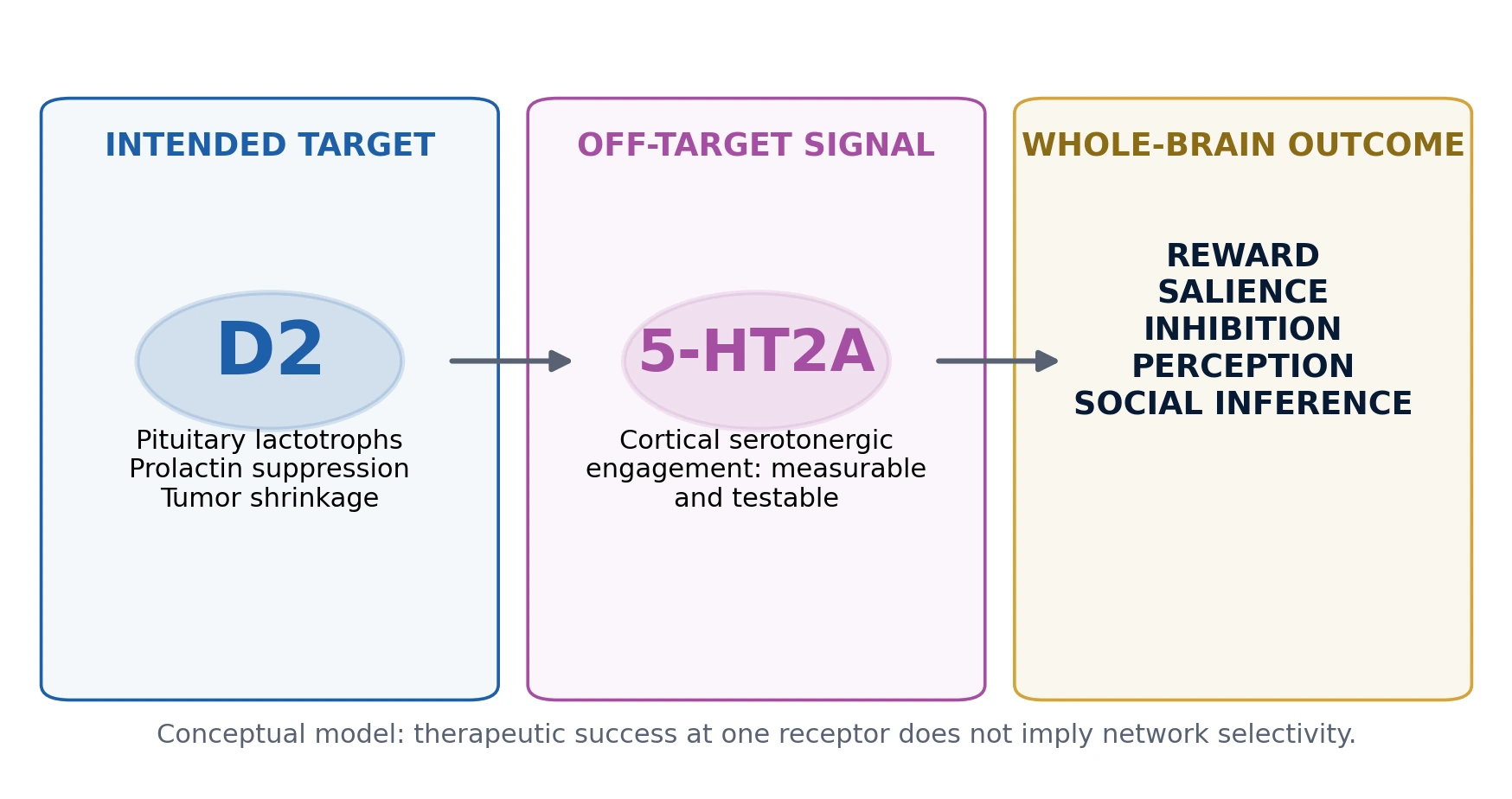
Intended target, off-target signal, whole-brain outcome
Conceptual systems model from the source monograph.
Cabergoline and bromocriptine are called dopamine agonists because D2 stimulation is the therapeutic mechanism sought in prolactinoma. That label does not mean their biological activity is restricted to dopamine receptors.
Functional human-receptor experiments found that bromocriptine and cabergoline display potent agonist properties at human 5-HT2A receptors. Cabergoline also displays pronounced 5-HT2B agonism, and both agents show activity across additional serotonin-receptor subtypes. Selective serotonin-receptor antagonists abolished relevant responses in the experimental receptor systems. [2,3]
The scientifically useful concept is not that one neurotransmitter "wins" or "prioritizes" over another. In vivo effects depend on concentration, affinity, intrinsic efficacy, receptor density, receptor state, blood-brain penetration, endogenous transmitter levels, signaling bias, downstream network organization, endocrine state, and patient-specific biology.
The central systems principle is simpler: a molecule prescribed for one receptor can still move other control surfaces in the brain. Off-target serotonin pharmacology is already clinically important for ergot-derived dopamine agonists in other organs; cabergoline's 5-HT2B agonism is relevant to fibrotic/valvular safety concerns at higher exposures. [1] The present paper asks whether off-target serotonergic pharmacology also matters to cognition.
The physician chooses D2 as the target; the molecule does not sign a contract to ignore the rest of the brain.
Why a women's safety lens is justified - and how to avoid overstating it
SOURCE MAPPDF pp. 13–14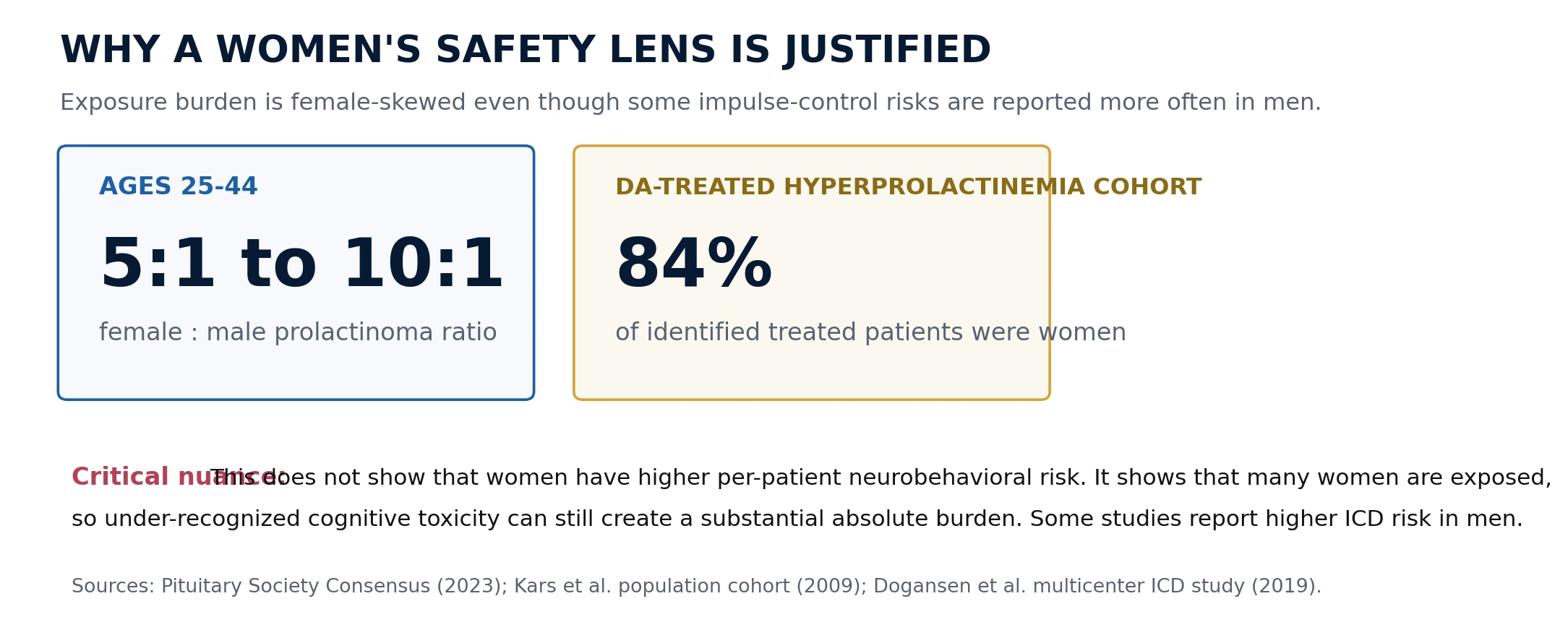
Women's safety exposure-burden figure
Source epidemiology/safety infographic from the monograph.
Prolactinomas disproportionately affect women during reproductive age. The Pituitary Society consensus reports a female-to-male ratio of approximately 5:1 to 10:1 between ages 25 and 44, with the sex difference diminishing after menopause. [1] A population study of dopamine-agonist-treated hyperprolactinemia identified 1,607 treated patients, 84% of whom were women; incidence peaked in women aged 25-34. [7]
That exposure pattern makes women's safety a legitimate research priority. It does not justify claiming that women have the highest per-patient rate of every dopamine-agonist behavioral complication. In the 2019 multicenter prolactinoma study, any impulse-control disorder was found in 17% of treated patients; hypersexuality and overall ICD burden were more common in men, while compulsive eating was more common in women. [6] A 2025 meta-analysis likewise found increased ICD risk overall and emphasized hypersexuality and punding, with important sex differences. [5]
The responsible conclusion is therefore an absolute-burden argument, not a simplistic relative-risk claim: because a large share of younger treated patients are women, under-recognized cognitive toxicity in even a minority can affect many women's relationships, fertility decisions, finances, driving, work, and personal safety.
This paper therefore proposes sex-stratified prospective research rather than assuming one sex has a universal vulnerability.
Protect women by measuring the right outcomes - without erasing evidence that men can have equal or greater risk for specific impulse-control syndromes.
The neuropsychiatric signal is already strong enough to demand structured measurement
SOURCE MAPPDF p. 14The exact prevalence of dopamine-agonist neurobehavioral toxicity varies by population, screening instrument, and study design. A 2025 clinical review summarized reported ICD prevalence across studies as roughly 7.5% to 46%. A 2025 systematic review and meta-analysis of eight studies encompassing 858 patients found dopamine-agonist therapy associated with higher ICD prevalence overall (RR 1.71, 95% CI 1.29-2.27), with particularly elevated estimates for hypersexuality and punding. [5]
A 308-patient multicenter study found any ICD in 17% - approximately one in six treated patients. [6] Current consensus and labeling recognize clinically meaningful behaviors including gambling, hypersexuality, compulsive spending, binge eating, aggression, mood changes, depression, mania, and psychotic disorder. [1,4]
The existence of the signal is therefore not hypothetical. The open mechanistic question is why the phenotype varies so widely between patients and whether some adverse states contain a serotonergic component that is currently collapsed into broad psychiatric labels.
The paper deliberately avoids claiming that every adverse event shares a single mechanism. Dopaminergic disinhibition, endocrine restoration, baseline psychiatric vulnerability, sleep disruption, serotonergic polypharmacology, and individual neurobiology may produce overlapping but distinct phenotypes.
The right next step is not a new label. It is better phenotyping.
5-HT2A and the altered-state hypothesis
SOURCE MAPPDF pp. 14–16
Patient Safety, Women, and the Whole Human
Conceptual scientific illustration from the source monograph; not patient data.
5-HT2A is a central molecular gateway for the acute effects of classical psychedelics. Human experiments show that blocking 5-HT2A can profoundly attenuate those effects. In a randomized, double-blind crossover study, ketanserin administered one hour after LSD substantially reversed the ongoing subjective response,
reducing average duration from about 8.5 hours to 3.5 hours and reducing visual, auditory, and ego-dissolution effects without materially altering LSD pharmacokinetics. [8]
This provides a powerful mechanistic principle: a psychoactive compound can remain present in the body while the characteristic cognitive state collapses when a critical receptor pathway is blocked.
The founder's hypothesis is not that dopamine agonists generate a stereotypical LSD trip. It is that some patients may enter a non-classical, dysphoric serotonergic altered state created by the interaction of 5-HT2A signaling with D2/D3-mediated changes in reward, salience, inhibition, and endocrine state.
Possible features to measure include derealization, unusual emotional salience, perceptual disturbance, paranoia, altered self-processing, anxiety, abnormal associative cognition, poor judgment, or a sense that the social world has become difficult to interpret. A patient may describe this simply as "depression" because the experience is miserable, even if the underlying phenomenology is not ordinary major depressive disorder.
That proposition is testable. If prospective altered-state instruments show no distinct phenotype beyond ordinary depression, the hypothesis weakens. If a reproducible subgroup emerges, it strengthens.
Do not argue over the word "psychedelic." Measure the state.
The founder's high-confidence PET prediction
SOURCE MAPPDF pp. 16–17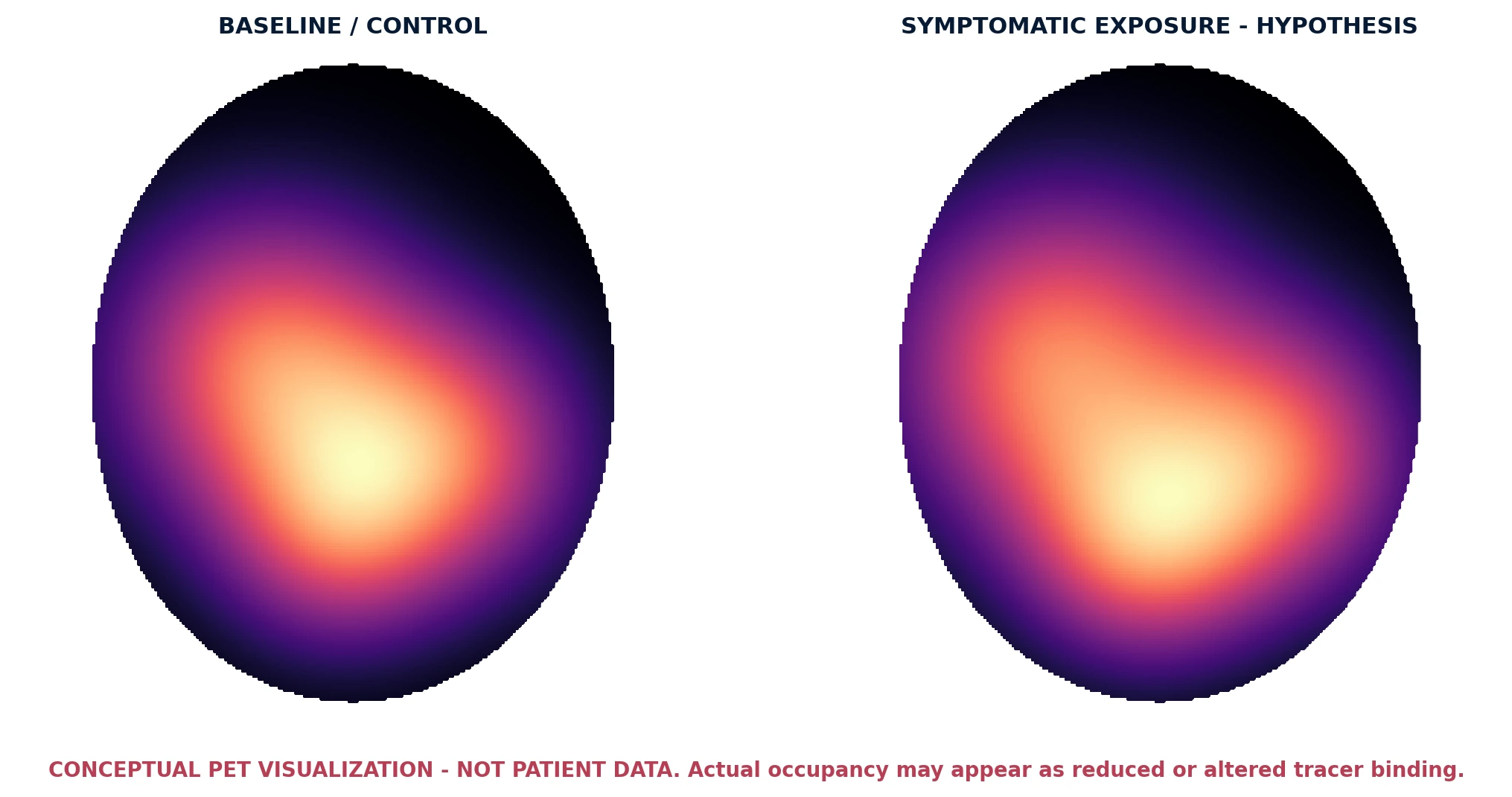
Conceptual PET prediction
Conceptual PET visualization from the source monograph; not patient data and not a literal brightness prediction.
The founder's qualitative prediction is strong: if the adverse cognitive state is substantially mediated by cortical 5-HT2A engagement, then receptor imaging performed during the symptomatic state should reveal a reproducible change in 5-HT2A binding or occupancy metrics relative to pretreatment baseline, asymptomatic treated patients, or matched controls.
Colloquially, the founder originally described this as expecting the relevant receptor system to "light up like a Christmas tree." That metaphor should not be confused with PET physics. Drug occupancy or endogenous neurotransmitter competition can appear as reduced or otherwise altered radioligand binding rather than a brighter image. The rigorous prediction is therefore large, measurable perturbation, not literal brightness.
Human 5-HT2A imaging is already technically possible. [18F]altanserin PET has been shown to map cortical 5-HT2A distribution in living humans with good agreement to postmortem receptor-density data. [12]
[11C]Cimbi-36 is an agonist PET radioligand validated for cortical 5-HT2A imaging; ketanserin pretreatment significantly decreases its cortical binding. [10] Modern work has also quantified 5-HT2A occupancy produced by ketanserin itself. [11]
This matters because the central question no longer requires inventing a new imaging modality. The laboratory tool exists. The unresolved problem is designing the right exposure, timing, control groups, tracer, and behavioral phenotyping so that the imaging result can distinguish receptor engagement from confounds.
The founder assigns a high prior plausibility to finding a measurable 5-HT2A perturbation in symptomatic patients based on the convergence of receptor pharmacology, 5-HT2A altered-state science, recognized dopamine-agonist neurobehavioral toxicity, and available PET methodology. That is a professional hypothesis - not a measured result - and this paper explicitly invites a laboratory to falsify it.
The claim becomes scientifically serious when it can be wrong in a specific way.
The experiment that could resolve the argument
SOURCE MAPPDF pp. 17–18A rigorous human study should recruit prolactinoma patients before dopamine-agonist therapy and establish a within-subject baseline.
Suggested groups:
- Cohort A: patients beginning cabergoline.
- Cohort B: patients receiving bromocriptine.
- Cohort C: where clinically available, patients receiving a more D2-specific non-ergot agonist such as quinagolide.
- Cohort D: appropriately matched prolactinoma patients managed surgically, observationally, or by another clinically justified pathway.
Before treatment, participants would undergo endocrine profiling, validated mood and impulse-control assessment, altered-state phenomenology instruments, sleep measures, cognitive inhibition tasks, decision-making tasks, and social-inference paradigms. Imaging would be added only where ethical and justified.
After clinically relevant exposure, the same measurements would be repeated. The critical subgroup is patients who develop a reproducible adverse neuropsychiatric phenotype. Event-linked 5-HT2A PET could then compare symptomatic exposure with baseline and appropriate controls.
The strongest evidence would not be a single cross-sectional scan. It would be convergence: exposure-response, within-subject change, symptom correlation, reversibility after medication change, differential effects between drugs with different receptor profiles, and - only when justified - a receptor-selective antagonist challenge.
The study should be designed to distinguish serotonin-receptor involvement from dopaminergic, endocrine, psychiatric, and nonspecific medication effects.
Driving, work, and real-world safety
SOURCE MAPPDF pp. 18–19If a patient is experiencing an unrecognized altered cognitive state, ordinary activities can become a safety issue because the patient may not know that perception, judgment, attention, or risk evaluation has changed.
It is not scientifically justified to say that prolactinoma patients taking cabergoline are generally "driving on psychedelics." That conclusion has not been established. But the driving question is legitimate even before the 5-HT2A hypothesis is proven. Cabergoline labeling and clinical guidance recognize dizziness, somnolence, abnormal vision, impaired concentration, compulsive behavior, psychotic disorder, and aggression. [4] Pfizer product information in some jurisdictions specifically warns patients with somnolence to refrain from driving or activities in which impaired alertness could cause serious injury or death. [17]
The founder's hypothesis raises a narrower additional question: do symptomatic patients show measurable changes in reaction time, hazard perception, divided attention, perceptual stability, or judgment beyond the known nonspecific effects?
A prospective study should therefore include psychomotor vigilance, divided-attention tasks, hazard perception, simulated driving, visual processing, and risk calibration. The public-safety issue is functional impairment, not the rhetorical label attached to it.
If cognition changes, driving safety should be measured directly rather than inferred from diagnosis labels.
Dopamine, risk, trust, and social inference
SOURCE MAPPDF p. 19Dopamine participates in reward learning, prediction error, action selection, and social belief updating. Human pharmacological experiments show that manipulating D2/D3 signaling can change how people use information under uncertainty.
In healthy volunteers, cabergoline altered risky choice by increasing sensitivity to probability information while decreasing discrimination according to the magnitude of potential losses; the magnitude and direction of the effect depended on baseline sensation-seeking traits. [14] In a separate human study, blocking D2/D3 receptors with sulpiride increased the volatility of beliefs while participants learned whom to trust in a repeated social interaction task. [13] Human PET work also demonstrates anatomical relationships between cortical 5-HT2A and D2 receptor systems, reinforcing the plausibility of network-level interaction rather than isolated transmitter "channels." [18]
These experiments do not show that dopamine agonists make a person "unable to trust." They demonstrate something more precise: dopaminergic signaling participates in the computational machinery used to evaluate risk and update beliefs about other people.
That creates a legitimate patient-safety question. If a susceptible patient simultaneously experiences increased reward drive, impaired inhibition, altered salience, mood/perceptual disturbance, and unstable social inference, could exposure to dangerous interpersonal situations increase? The answer is unknown, but it should be studied.
Social judgment is a biological function. If treatment perturbs the machinery that supports it, medicine should measure the consequence.
Interpersonal vulnerability: a necessary but ethically bounded research question
SOURCE MAPPDF pp. 19–20The founder has raised a serious concern: a patient with hypersexuality, impulsivity, impaired risk evaluation, paranoia, mania, psychosis, or distorted social inference may become easier to exploit or may enter relationships and situations she or he would ordinarily recognize as unsafe.
There is currently insufficient evidence to claim that dopamine-agonist therapy causes rape, trafficking, interpersonal exploitation, or violent victimization. Those outcomes must not be presented as established adverse effects.
But absence of evidence is not a reason to refuse measurement when the pathway is biologically plausible and the stakes are high. A future safety registry could prospectively examine severe relationship disruption, coercive sexual encounters, financial exploitation, abrupt high-risk relationship formation, interpersonal violence, or repeated unsafe trust decisions, using strict ethical safeguards and trauma-informed methods.
This is especially relevant to a women's-health research program because many younger treated patients are women. It is also relevant to men because impulse-control disorders and hypersexuality can be more common in male patients. The goal is not to assign blame to patients. It is to identify whether treatment can change the cognitive machinery that ordinarily protects a person from danger.
Do not claim victimization is a drug effect. Do ask whether treatment changes the capacities that help people avoid victimization.
Cyclobenzaprine: an intriguing clue, not a cure
SOURCE MAPPDF pp. 20–21Cyclobenzaprine is usually described as a centrally acting skeletal-muscle relaxant, but its pharmacology is considerably broader. Receptor profiling found its most potent interaction among the tested targets at 5-HT2A; functional antagonistic potency was reported at approximately Kb 28.78 nM. It also interacts with additional serotonin receptors and monoamine transporters. [9]
Informal reports from psychedelic-drug communities claim that cyclobenzaprine can markedly attenuate or terminate an LSD experience. Those reports are uncontrolled and vulnerable to expectancy, timing, co-ingestants, sedation, and selective reporting. They should therefore be treated as hypothesis-generating observations rather than evidence of efficacy.
The reason the observation remains scientifically interesting is convergence. Classical LSD effects depend strongly on 5-HT2A signaling, controlled human work shows that ketanserin can reverse an established LSD state, and cyclobenzaprine has demonstrable 5-HT2A antagonistic activity. [8,9]
That sequence supports a mechanistic question: if a portion of dopamine-agonist neuropsychiatric toxicity is mediated by 5-HT2A, can blocking 5-HT2A reduce the adverse phenotype while leaving D2-mediated prolactin suppression intact?
Cyclobenzaprine is one clue toward that question. It is not presently the answer.
Anecdote can generate a good experiment. It cannot substitute for one.
Why cyclobenzaprine should not yet be prescribed for this purpose
SOURCE MAPPDF p. 21Cyclobenzaprine is not a selective 5-HT2A antagonist. It interacts with multiple serotonin receptors, serotonin and norepinephrine transporters, histamine H1 receptors, muscarinic systems, and other targets. Its serotonergic properties are sufficiently complex that the literature discusses possible serotonin syndrome in multidrug serotonergic exposure. [9]
For that reason, the word "microdose" is not an adequate safety argument. A low dose is not automatically a selective dose. A rational repurposing program would need to establish pharmacokinetics, central receptor occupancy, minimum effective antagonistic exposure, sedation, cardiovascular effects, anticholinergic burden, serotonin-toxicity risk, and interactions with cabergoline or bromocriptine.
The scientifically cleaner causal experiment would begin with a more selective 5-HT2A antagonist under controlled research conditions. Only if selective antagonism improves the phenotype while preserving endocrine efficacy should clinically available compounds such as cyclobenzaprine be evaluated as practical alternatives.
Mechanism first. Repurposing second.
This paper must never be interpreted as advice to combine cyclobenzaprine with cabergoline outside a clinical research protocol.
Could receptor-selective mitigation expand the medical therapeutic window?
SOURCE MAPPDF pp. 21–22If 5-HT2A contributes materially to dose-limiting neuropsychiatric toxicity, then receptor-selective mitigation could theoretically expand the usable therapeutic window of dopamine-agonist treatment in selected patients. That might matter in resistant tumors where additional endocrine effect is sought.
This possibility must be stated with restraint. Higher cabergoline exposure carries independent risks, and additional dose does not guarantee additional benefit. Consensus guidance notes that commonly used cabergoline doses range up to several milligrams per week and recommends additional cardiac surveillance when long-term doses exceed 2 mg per week. [1] In a 122-patient macroprolactinoma study, most patients were controlled at 1.5 mg/week or less, some partial responders benefited from escalation, but doses beyond 3.5 mg/week showed no clear additional advantage. [16]
Therefore the future strategy is not "block serotonin and raise cabergoline indefinitely." It is to ask whether a receptor-selective intervention can safely separate the wanted endocrine mechanism from an unwanted cognitive mechanism, and whether doing so changes the dose-response curve enough to matter clinically.
If the answer is yes, a new therapeutic branch may exist. If no, the safer choice for some patients may be another dopamine agonist, dose reduction, withdrawal when appropriate, or surgery.
The goal is not a higher dose. The goal is a wider margin between benefit and harm.
Medication versus surgery: the risk-benefit equation may change
SOURCE MAPPDF pp. 22–23The choice should not be framed as a harmless pill versus frightening brain surgery. Contemporary prolactinoma care is more nuanced. The Pituitary Society recommends discussing the curative potential and risks of surgery with appropriate patients, particularly those with microprolactinomas or surgically favorable, well-encased macroprolactinomas. Dopamine-agonist intolerance is also a reason to reconsider alternative treatment. [1]
For many patients, medical therapy remains the best option. For others, persistent neurobehavioral toxicity could materially alter the balance. The correct comparison is:
- medical efficacy + medical toxicity + duration of exposure + reversibility;
- versus surgical cure probability + operative risk + recurrence risk + local expertise.
If future research shows that a subset of patients experiences substantial receptor-mediated cognitive toxicity, then the definition of "medication intolerance" should include that burden explicitly rather than treating it as peripheral to tumor control.
Conversely, if selective mitigation safely removes that toxicity, medicine might preserve the advantages of pharmacologic treatment for patients who would otherwise require surgery.
The right treatment is the one with the best whole-person risk-benefit profile, not the one that wins by category label.
A patient can be biologically treated and cognitively harmed
SOURCE MAPPDF p. 23Clinical care is often divided by specialty. Endocrinology measures prolactin. Radiology measures tumor size. Neurosurgery evaluates anatomy. Psychiatry evaluates mood and behavior. Pharmacology characterizes receptor activity. Nuclear medicine can measure receptor binding. The patient experiences all of those systems simultaneously.
That fragmentation can produce an epistemic blind spot. A chart can show normalized prolactin and shrinking tumor while the family reports that the patient's spending, sexuality, judgment, mood, sleep, or personality changed dramatically.
The founder's systems argument is that local success does not guarantee global success. A complete model must measure both the biological target and the cognitive organism in which that target exists.
This is not an argument against dopamine agonists. These medications are highly valuable. It is an argument for measuring what they do to the entire system.
Endocrine success and cognitive safety are not competing truths. They are both required outcomes.
The deeper systems-neuroscience model
SOURCE MAPPDF pp. 23–24Biological cognition is not generated by isolated receptors. Neuromodulators alter gain, salience, action selection, learning rate, confidence, inhibition, network recruitment, and state transitions. Endocrine changes also feed back into the nervous system.
A simplified systems representation is:
Drug exposure -> D2/D3 + serotonergic + other receptor engagement -> endocrine normalization + altered reward/salience/inhibition/perception -> behavior -> environmental feedback -> new cognitive state.
The resulting phenotype depends on the entire loop, not on one arrow. The same receptor perturbation may produce different experiences in different people because baseline personality, receptor density, genetics, sleep, sex hormones, prior psychiatric vulnerability, other medications, and social environment all change the network state.
This is why the paper rejects simplistic language such as "serotonin beats dopamine" or "D2 destroys trust." The correct object of study is the interacting cognitive system.
A receptor is not a behavior. It is a control variable inside an architecture.
Why synthetic-brain engineering generated this hypothesis
SOURCE MAPPDF p. 24The founder's work on XERXES - a synthetic-neuron cognitive architecture - is relevant to the origin of this hypothesis, but it is not evidence that the hypothesis is true.
Engineering synthetic cognition forces a designer to ask questions that are easy to miss when biological cognition is split across specialties: What changes network priority? What changes salience? What recruits or suppresses another subsystem? What happens when several modulators act simultaneously? How does a local optimization create a global failure mode? How does the system detect that its own confidence has become unreliable?
In a designed cognitive architecture, changing a regulator can reorganize the behavior of the entire system even when the regulator itself is not the information being processed. The founder saw a possible biological analogue: a medication chosen for endocrine D2 action may simultaneously change serotonergic and dopaminergic control variables that reshape cognition.
The credibility of the resulting medical hypothesis must come from pharmacology, clinical observations, imaging, and falsification - not from biography. What the founder's engineering work demonstrates is the cross-domain systems lens that made the question visible.
For investors, that distinction is important. The value of a brain architect is not the ability to sound certain about every domain. It is the ability to reduce a complicated cross-domain observation into a model that can be tested, corrected, and improved.
The founder contribution is the systems-level detection of a blind spot; science must decide whether the blind spot is real.
The founder's formal predictions
SOURCE MAPPDF p. 25Prediction 1. Patients who develop substantial neuropsychiatric symptoms during cabergoline or bromocriptine therapy will show a measurable change in cortical 5-HT2A PET metrics relative to their pretreatment baseline and/or asymptomatic treated controls.
Prediction 2. In a definable subgroup, the magnitude or regional pattern of the receptor-imaging change will correlate more strongly with altered-state phenomenology than with conventional depression scores alone.
Prediction 3. A selective 5-HT2A antagonist, tested under an ethically approved protocol, will reduce the abnormal cognitive phenotype without proportionally reversing D2-mediated prolactin suppression if 5-HT2A causally contributes.
Prediction 4. A dopamine agonist with greater D2 specificity and less 5-HT2A activity will produce a different neurobehavioral profile at comparable endocrine efficacy if off-target serotonin signaling contributes materially.
Prediction 5. Patients with the adverse phenotype will show measurable functional differences in one or more domains such as risk weighting, impulse control, perceptual stability, social inference, driving-related attention, or sleep.
Prediction 6. If receptor imaging, comparative pharmacology, and antagonist challenge fail to support these relationships, the 5-HT2A hypothesis should be rejected or substantially revised.
A hypothesis is most useful when it tells opponents exactly how to defeat it.
A staged research program
SOURCE MAPPDF pp. 25–28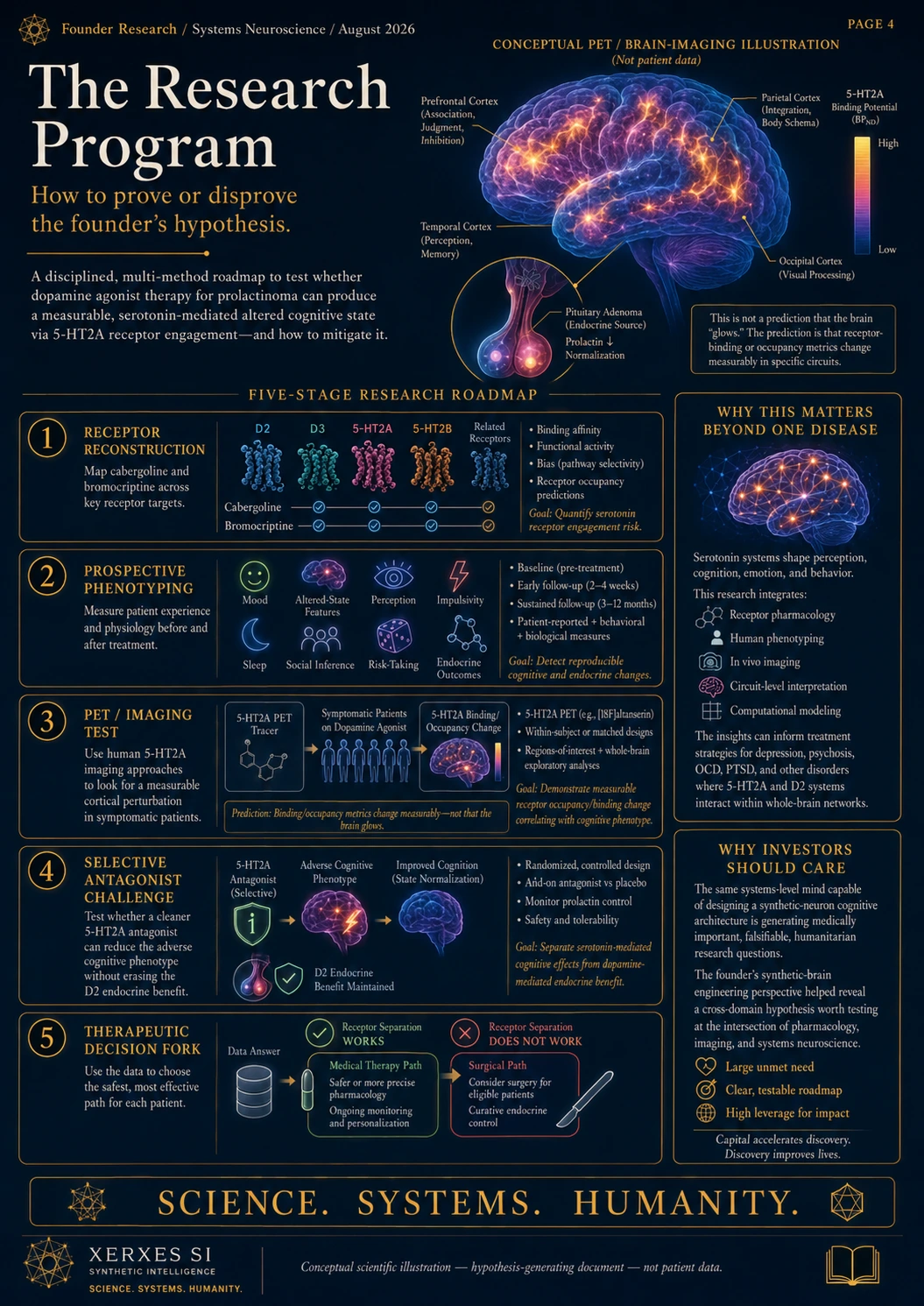
The Research Program
Conceptual research-program infographic from the source monograph.
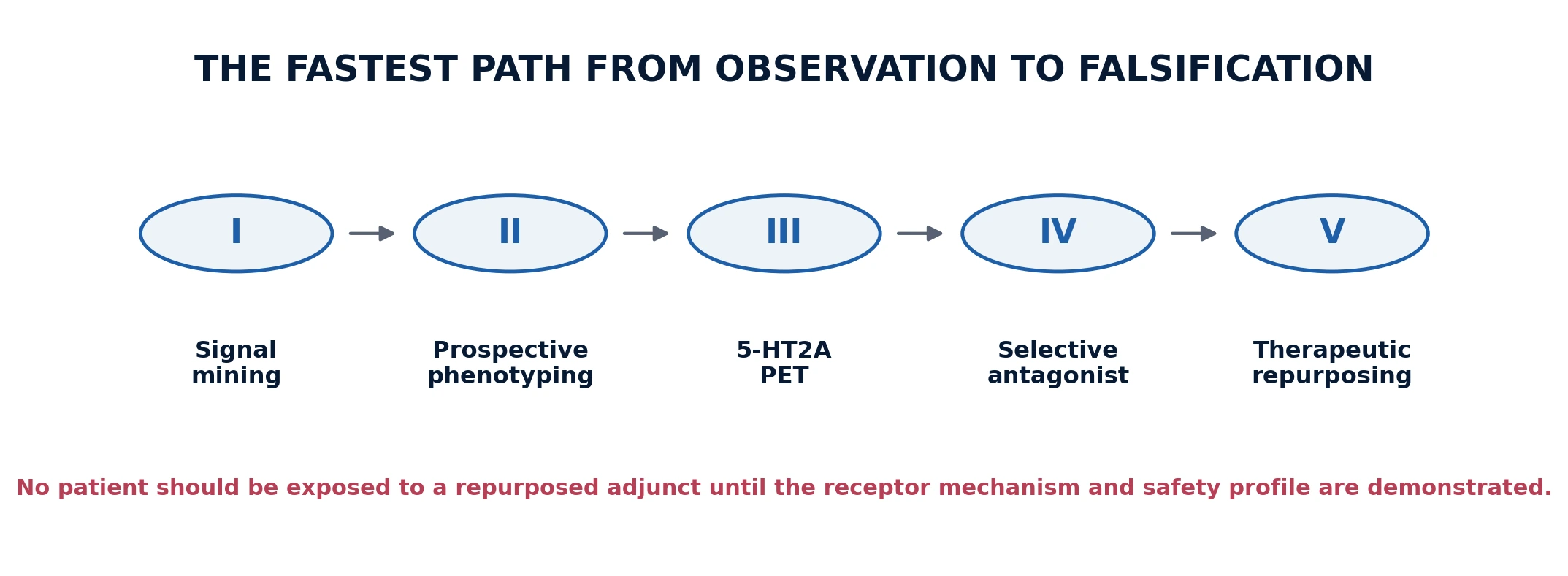
Fastest path from observation to falsification
Source research-sequence diagram; emphasizes no repurposed adjunct before mechanism and safety are demonstrated.
Phase I - Receptor and exposure reconstruction. Build contemporary functional profiles for cabergoline and bromocriptine across D2, D3, 5-HT2A, 5-HT2B, 5-HT2C, 5-HT1A/1D, adrenergic, and other relevant targets. Distinguish binding from signaling efficacy and map therapeutic plasma exposure to plausible central receptor engagement. [2,3]
Phase II - Retrospective signal mining. Analyze clinical records and pharmacovigilance data for the timing of drug initiation, dose escalation, prolactin normalization, endocrine recovery, depression diagnoses, mania, psychosis, hypersexuality, gambling, compulsive spending/eating, aggression, emergency psychiatric presentation, and functional safety incidents.
Phase III - Prospective phenotyping. Enroll patients before treatment and serially measure endocrine variables, PHQ-9 or equivalent mood instruments, mania and psychosis measures where indicated, altered-state phenomenology, sleep, impulse control, decision-making, and social cognition. Include collateral observation from partners or family only with appropriate consent.
Phase IV - PET imaging. Use validated 5-HT2A PET methods in carefully selected baseline, symptomatic, asymptomatic, and recovery states. Interpretation must account for tracer-specific sensitivity to receptor occupancy and endogenous serotonin. [10,11,12]
Phase V - Selective antagonist challenge. Only after a reproducible signal exists should an IRB-approved receptor-selective intervention test causality.
Phase VI - Therapeutic repurposing or redesign. If the mechanism is confirmed, evaluate whether a clinically practical antagonist, more selective dopamine agonist, or altered dosing strategy can preserve endocrine benefit with less cognitive toxicity. Cyclobenzaprine would be only one candidate to study after mechanism and safety are established.
Phase VII - Multidisciplinary treatment outcomes. Compare continued medical therapy, selective mitigation, alternative dopamine agonists, and surgery using whole-person endpoints rather than prolactin alone.
The fastest path to a safe therapy begins with the cheapest falsification steps, not with prescribing the proposed solution.
Immediate patient-safety improvements do not require proving the hypothesis
SOURCE MAPPDF p. 28Even if the entire 5-HT2A mechanism is ultimately wrong, existing evidence already supports better behavioral monitoring. Consensus guidance recommends screening for mood changes and impulse-control disorders and notes that discussion with partners or family can be important because patients may hide or fail to recognize harmful behaviors. [1] Current U.S. labeling likewise tells clinicians to ask specifically about gambling, sexual urges, uncontrolled spending, binge eating, and other intense urges. [4]
A practical safety protocol should ask about:
- new gambling or uncontrolled spending;
- unusual sexual urges or risky sexual behavior;
- binge eating or repetitive compulsive behavior;
- aggression or marked irritability;
- major mood change, decreased need for sleep, or mania;
- hallucinations, paranoia, or psychotic symptoms;
- unusual perceptual or derealization experiences;
- dangerous changes in judgment or risk-taking;
- impaired concentration, somnolence, dizziness, or driving concerns;
- suicidal thinking or self-harm symptoms.
These questions should be asked before therapy and during follow-up, not only after a crisis. Patients and families should receive clear instructions that behavioral changes can be medication-related and deserve prompt evaluation.
The minimum whole-person outcome set should become: tumor response + endocrine response + cardiovascular safety + cognitive/behavioral response + quality of life + functional safety.
The paper can improve safety before it proves its mechanism.
What is established, what is plausible, and what is not yet proven
SOURCE MAPPDF p. 29Established:
- D2 agonism is the desired prolactin-lowering mechanism in prolactinoma. [1]
- Cabergoline and bromocriptine show serotonergic polypharmacology including functional 5-HT2A agonism in human receptor systems. [2,3]
- Dopamine-agonist treatment can be associated with serious neuropsychiatric and impulse-control effects. [1,4,5,6]
- 5-HT2A is central to classical psychedelic phenomenology, and 5-HT2A antagonism can markedly reverse an established LSD state. [8]
- Cyclobenzaprine has measurable 5-HT2A antagonistic activity but is pharmacologically nonselective. [9]
- Human 5-HT2A PET imaging and occupancy measurement are technically feasible. [10,11,12]
Plausible but unproven:
- Therapeutic cabergoline or bromocriptine exposure produces clinically important cortical 5-HT2A engagement in a symptomatic prolactinoma subgroup.
- Some adverse experiences labeled depression contain a dysphoric serotonergic altered-state component.
- 5-HT2A engagement interacts with dopaminergic changes in reward, risk, inhibition, and social inference to increase functional danger in some patients.
Not established:
- That dopamine-agonist patients are generally in a psychedelic state.
- That these medications cause rape, trafficking, or interpersonal victimization.
- That cyclobenzaprine is a safe antidote or adjunct for dopamine-agonist psychiatric effects.
- That blocking 5-HT2A makes higher dopamine-agonist doses safe.
- That medication is categorically better or worse than surgery.
These boundaries are not hedges. They are what turn a provocative observation into a credible research program.
The paper is strongest where it makes the line between evidence and inference impossible to miss.
Conclusion: what state does the whole brain enter while the tumor is being treated?
SOURCE MAPPDF p. 30Medicine knows why cabergoline and bromocriptine are prescribed: D2 agonism suppresses prolactin and often shrinks prolactinomas. Pharmacology knows something broader: these molecules interact with serotonin receptors, including 5-HT2A. Clinical medicine knows another fact: some patients develop serious changes in mood, impulse control, sexuality, aggression, judgment, or psychosis. Psychedelic neuroscience knows that 5-HT2A activation can radically alter cognition and that antagonizing that receptor can rapidly collapse an ongoing LSD state. Human neuroimaging knows how to measure the receptor system in vivo. [1,2,4,8,10]
Those literatures are usually encountered separately. This paper connects them and asks whether the connection is causal.
The hypothesis may be wrong. If PET, phenotyping, comparative pharmacology, and antagonist studies show no relevant 5-HT2A contribution, the model should be rejected.
If the hypothesis is right, a class of adverse states currently treated as an unavoidable or poorly characterized cost of dopamine-agonist therapy may become mechanistically understandable. That could change screening, driving and occupational counseling, medication selection, dose strategy, surgical decision-making, and eventually the design of safer therapies.
The humanitarian case is especially clear for women because prolactinoma treatment disproportionately affects women of reproductive age, while the cognitive consequences under investigation can touch relationships, fertility, employment, finances, and personal safety. [1,7] But the research must remain sex-inclusive because some impulse-control outcomes are more common in men. [5,6]
The founder's larger systems lesson is equally simple: a biological treatment cannot be fully understood by measuring only the biological component we intended to change.
The question is not only: Did the drug shrink the tumor?
The deeper question is: What state did the entire brain enter while the drug was doing it?
That question is answerable. And because the answer could improve both medical treatment and the protection of vulnerable patients, it deserves to be asked with urgency, precision, and scientific humility.
Science. Systems. Humanity. Build the model, test it hard, and protect the patient either way.
Selected references
SOURCE MAPPDF p. 31These references support the established clinical, pharmacological, imaging, and behavioral premises used to construct the hypothesis. They do not by themselves establish the paper's proposed 5-HT2A mechanism in prolactinoma patients.
Pituitary Society international Consensus Statement
Petersenn S, Fleseriu M, Casanueva FF, et al. Diagnosis and management of prolactin-secreting pituitary adenomas. Nature Reviews Endocrinology. 2023.
OPEN SOURCE ↗RECEPTOR PHARMACOLOGYpubmed.ncbi.nlm.nih.govSerotonin-receptor actions of antiparkinson agents
Newman-Tancredi A, Cussac D, Quentric Y, et al. Differential actions of antiparkinson agents at multiple classes of monoaminergic receptor. III. Journal of Pharmacology and Experimental Therapeutics. 2002;303:815-822.
OPEN SOURCE ↗RECEPTOR PHARMACOLOGYpubmed.ncbi.nlm.nih.govBinding profiles of antiparkinson agents
Millan MJ, Maiofiss L, Cussac D, et al. Differential actions of antiparkinson agents at multiple classes of monoaminergic receptor. I. Journal of Pharmacology and Experimental Therapeutics. 2002;303:791-804.
OPEN SOURCE ↗U.S. DRUG LABELdailymed.nlm.nih.govCabergoline tablets prescribing information
DailyMed cabergoline labeling; source paper cites warnings regarding impulse-control disorders, compulsive behaviors, psychotic disorder, and aggression.
OPEN SOURCE ↗SYSTEMATIC REVIEW / META-ANALYSISpubmed.ncbi.nlm.nih.govImpulse control disorders in prolactinoma - systematic review and meta-analysis
Penchev P, Milanova-Ilieva D, Gaydarski L, et al. Journal of Clinical Neuroscience. 2025;138:111363.
OPEN SOURCE ↗MULTICENTER CLINICAL STUDYpubmed.ncbi.nlm.nih.govDopamine agonist-induced impulse control disorders in prolactinoma
Ciftci Dogansen S, Cikrikcili U, Oruk G, et al. Journal of Clinical Endocrinology & Metabolism. 2019;104:2527-2534.
OPEN SOURCE ↗EPIDEMIOLOGYpubmed.ncbi.nlm.nih.govAge- and sex-specific dopamine-agonist-treated hyperprolactinemia epidemiology
Kars M, Souverein PC, Herings RMC, et al. Journal of Clinical Endocrinology & Metabolism. 2009.
OPEN SOURCE ↗RANDOMIZED HUMAN EXPERIMENTpubmed.ncbi.nlm.nih.govKetanserin reverses the acute response to LSD
Becker AM, Klaiber A, Holze F, et al. International Journal of Neuropsychopharmacology. 2023;26:97-106.
OPEN SOURCE ↗PHARMACOLOGY / SAFETYpmc.ncbi.nlm.nih.govCyclobenzaprine pharmacology and serotonin syndrome
Mestres J, Seifert SA, Oprea TI. Clinical Pharmacology & Therapeutics. 2011;90:662-665.
OPEN SOURCE ↗PET IMAGINGpubmed.ncbi.nlm.nih.gov[11C]Cimbi-36 human 5-HT2A PET
Ettrup A, da Cunha-Bang S, McMahon B, et al. Journal of Cerebral Blood Flow & Metabolism. 2014.
OPEN SOURCE ↗PET OCCUPANCYpubmed.ncbi.nlm.nih.govKetanserin 5-HT2A receptor occupancy
Kleinloog D, et al. European Neuropsychopharmacology. 2024.
OPEN SOURCE ↗PET IMAGINGpubmed.ncbi.nlm.nih.gov[18F]altanserin PET distribution of human 5-HT2A receptors
Kassubek J, Juengling FD, Hellwig B, et al. 2002.
OPEN SOURCE ↗HUMAN PHARMACOLOGYnature.comD2/D3 blockade and volatility of trust beliefs
Mikus N, Eisenegger C, Mathys C, et al. Nature Communications. 2023;14:4049.
OPEN SOURCE ↗HUMAN PHARMACOLOGYpubmed.ncbi.nlm.nih.govDopamine modulation of risk-taking
Norbury A, Manohar S, Rogers RD, Husain M. Journal of Neuroscience. 2013.
OPEN SOURCE ↗CLINICAL REFERENCEniddk.nih.govNIDDK prolactinoma treatment overview
National Institute of Diabetes and Digestive and Kidney Diseases. Prolactinoma.
OPEN SOURCE ↗CLINICAL STUDYpubmed.ncbi.nlm.nih.govCabergoline resistance in macroprolactinomas
Delgrange E, Daems T, Verhelst J, et al. European Journal of Endocrinology. 2009.
OPEN SOURCE ↗PRODUCT INFORMATIONlabeling.pfizer.comDostinex product information - driving and somnolence cautions
Pfizer international product information for Dostinex (cabergoline).
OPEN SOURCE ↗PET / NEUROIMAGINGpubmed.ncbi.nlm.nih.govHuman 5-HT2A and D2 receptor anatomical relationships
Matsuda M, et al. 2017/2018.
OPEN SOURCE ↗Appendix A // database ingestion contract
SOURCE MAPPDF p. 32The PDF is the human-readable publication. The companion JSON and Markdown files are the machine-ingestion forms. Each object should preserve the following fields so that future revisions can be compared without silently changing the founder's hypothesis.
| Field | Purpose |
|---|---|
| object_id | Stable database identity. Do not recycle. |
| title | Human and machine-readable section title. |
| evidence_class | ESTABLISHED / SUPPORTED / HYPOTHESIS / EXPLORATORY / SAFETY BOUNDARY / PROPOSED STUDY. |
| keywords | Search and graph traversal terms. |
| body | Complete section text. |
| takeaway | Short human-readable significance statement. |
| source_references | Reference numbers or URLs supporting factual premises. |
| revision_date | Date of material change. |
| claim_status | Current, qualified, superseded, or falsified. |
| public_safety | Whether the object contains clinical-safety language requiring preservation. |
The hypothesis may be refined as evidence arrives, but prior public versions should remain archived. If a prediction is falsified, mark it falsified rather than quietly deleting it. That is how a research corpus earns trust.
Clinical safety notice // closing principle
SOURCE MAPPDF p. 33A good hypothesis is not protected from criticism. It is designed to survive or fail in public. A good medical system is not satisfied because a tumor shrank. It asks whether the person remained safe, autonomous, and cognitively whole.
Keep exploring // human pathways
Continue through adjacent ideas, products, principles, and historical lineages. These pathways preserve the relationships in the underlying knowledge graph while keeping exploration natural for a human reader.
 entityThe Founder
A privacy-preserving founder profile focused on technical lineage, systems literacy, operating philosophy, cross-domain study, and the design principles visible in XERXES SI—without publishing age, identity, or unnecessary personal detail.
CONTINUE →entityXERXES SIXERXES SI is the company entity connecting the public product, architecture, demonstration, evidence, investor, and knowledge properties.
CONTINUE →principleReproducible Modular WorkflowThe XERXES founder philosophy that systems should be reproducible, modular, checkpointed, evidence-bearing, and resistant to one-off server craftsmanship.
CONTINUE →conceptSystems LiteracySystems literacy is the practice of understanding enough of a system’s layers—physical, logical, organizational, and human—to reason about how it behaves, where it fails, and what can safely change.
CONTINUE →